
Aug 17, 2026 by Anthony York (YorkSoft Ltd)
Last Updated: August 17, 2026
Professional services firms, law practices, accountancies, consultancies, and medical centres, operate in a world of strict compliance, sensitive client data, and complex workflows. Off-the-shelf website platforms weren't designed for these realities. They lack the security depth, integration flexibility, and regulatory alignment that professional services demand.
Bespoke web development for professional services addresses this gap directly. A custom-built application handles client intake forms that feed directly into your case management system. It manages appointment scheduling with automatic conflict detection. It stores sensitive documents in encrypted, access-controlled repositories that comply with professional body regulations.
The difference between a generic website and a bespoke solution is the difference between a filing cabinet and a fully integrated records system. One stores information. The other works with your business.
YorkSoft Ltd specialises in building these systems for professional services firms across the UK. We understand that your website isn't just a marketing tool, it's a client-facing extension of your operations. When it's built properly, it reduces manual data entry, cuts appointment no-shows, and keeps client information secure without requiring constant oversight.
Professional services clients expect to manage their relationship with you online. They want to upload documents, check case status, book appointments, and communicate securely without picking up the phone or sending unencrypted emails. A bespoke web application delivers this through a dedicated client portal.
Client portals in custom applications work differently from generic portal templates. They integrate directly with your internal systems. When a client uploads a document through the portal, it automatically appears in your case management software. When you update their case status in your back office, the portal reflects that change instantly. No manual syncing. No data living in multiple places.

Data security in professional services isn't optional, it's mandatory. The Data Protection Act 2018 (which incorporates UK GDPR) requires that personal data be processed lawfully, fairly, and transparently. Client information must be encrypted both in transit and at rest. Access must be restricted to authorised personnel only. Audit trails must track who accessed what data and when.
A bespoke application enforces these requirements at the database level. You don't rely on users remembering to password-protect files or encrypt emails. The system enforces encryption automatically. Role-based access controls ensure that junior staff can't access partner-level information. Audit logging creates an immutable record of every data access for compliance reviews.
Integration is where custom development saves the most time. Your practice management software, accounting system, document repository, and email platform all exist in separate silos by default. Bespoke development connects them. When a new client signs on, their information flows into accounting automatically. When an invoice is generated, it triggers a client notification through the portal. When a deadline approaches, the system alerts the responsible team member.
These integrations eliminate the manual work that grows with your firm's size. At five staff, you manage it manually. At fifty staff, manual processes become bottlenecks. At five hundred staff, they become impossible.
Building a website for professional services requires attention to areas that generic web development often misses.
Professional services firms compete for visibility in highly specific search categories. A solicitor in Northampton needs to rank for "family law solicitor near me" and "conveyancing Northampton," not generic "solicitor" queries. Technical SEO ensures your website structure, metadata, and content architecture support these specific searches.
Bespoke development allows you to implement technical SEO from the foundation. Your URL structure can reflect service categories and locations. Your heading hierarchy can emphasise the services that matter most. Your schema markup can tell search engines exactly what services you offer and where you offer them.
Site speed matters more for professional services websites than for many other sectors. When a potential client is searching for urgent legal advice or medical consultation, they're impatient. Pages that load in under two seconds see significantly higher engagement than those taking four seconds or more. Custom development allows you to optimise every asset, images compressed without quality loss, code minified, caching strategies tailored to your content patterns.
Internal linking strategy in professional services websites should guide visitors toward conversion paths. A visitor arriving on your "employment law" page should find clear links to related services, case studies, and contact forms. A bespoke application can implement intelligent internal linking that adapts based on user behaviour and service relevance.
Professional services handle personal data as a core function. Client names, contact details, case information, medical histories, financial records, all of this is personal data under UK GDPR. Your website must handle it securely and document how you're handling it.
Bespoke development embeds GDPR compliance into the application architecture. When a client submits a form through your website, that data is encrypted immediately. The system logs what data was collected, when, and for what purpose. When a client requests deletion of their data, the system can identify and remove all instances across connected databases.
Consent management becomes automatic in a custom system. Before collecting marketing data, your website captures explicit consent. The system records when consent was given, what was consented to, and provides a simple mechanism for clients to withdraw consent later. This isn't just legally safer, it's operationally simpler than managing spreadsheets of consent records.
Data retention policies can be enforced automatically. If your firm's policy is to delete closed case files after seven years, the system can be configured to flag and delete those records automatically. No human needs to remember to do it. No compliance officer needs to manually audit whether it happened.
Understanding the cost structure of bespoke development helps you evaluate whether custom solutions make financial sense for your firm.
Custom web application development involves several cost categories: discovery and requirements gathering, design and user experience, development of core functionality, integration with your existing systems, security implementation and testing, and ongoing maintenance and support.
The discovery phase typically involves interviews with key staff, analysis of your current workflows, and documentation of requirements. This phase is critical, the more thoroughly you define what you need, the fewer costly changes occur later. A thorough discovery process often prevents expensive rework.
Development costs scale with complexity. A simple client portal with document upload and status tracking costs less than a comprehensive case management system with multiple user roles, advanced reporting, and third-party integrations. A system that integrates with five external platforms costs more than one that stands alone.
The cost-benefit calculation for bespoke development depends on your firm's size and complexity. Pricing depends on the specific requirements of your project. YorkSoft Ltd provides detailed quotes based on your specific requirements. Rather than guessing at a price, we work with you to understand your needs, then provide a transparent estimate. Contact us for a consultation to discuss your requirements and get a tailored proposal.
The process of building a bespoke web application for professional services follows a structured approach that reduces risk and ensures the final product meets your needs.
The process begins with discovery. You meet with our team to discuss your current workflows, pain points, and goals. We ask detailed questions about how clients interact with your firm, what data you need to collect, what integrations matter most, and what compliance requirements apply. We document existing systems you need to connect to. We identify staff who'll use the system and understand their needs.
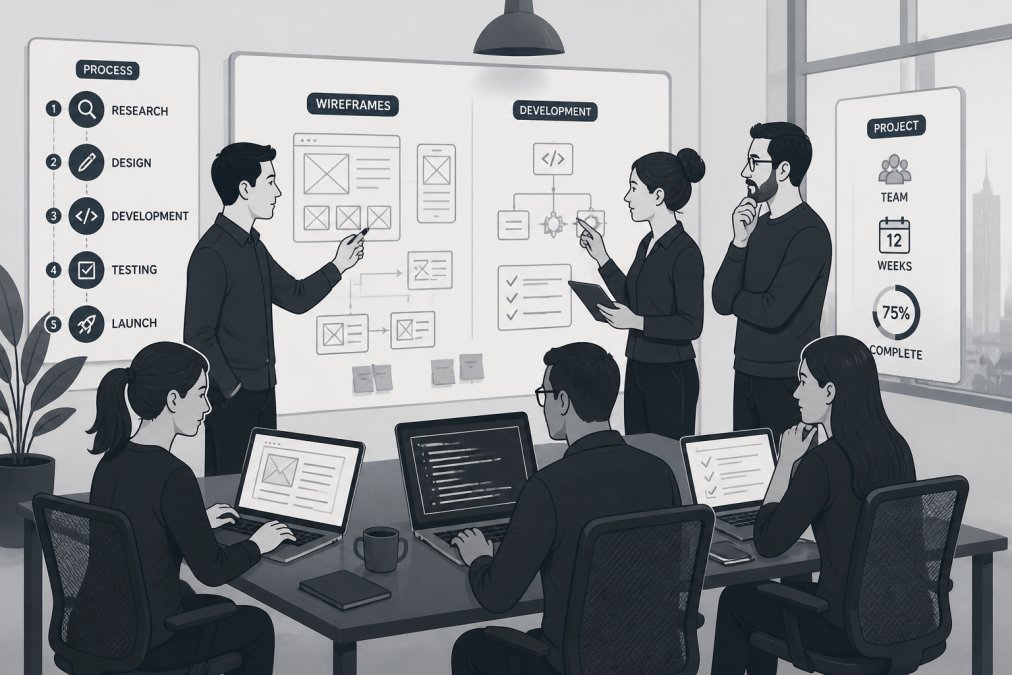
Once discovery is complete, we move to design. User experience design focuses on how your clients and staff will interact with the system. We create wireframes showing page layouts and user flows. We design the client portal interface so it's intuitive for users with varying technical skill. We design the back-office interface so your staff can manage cases, clients, and documents efficiently.
Development comes next. Our developers build the application according to the design specifications. We use modern frameworks and languages that prioritise security, performance, and maintainability. We build automated tests so we can verify that each feature works correctly. We implement security measures including encryption, authentication, and access controls.
Integration is where custom development connects to your existing systems. We configure APIs to transfer data between your new application and your practice management software, accounting system, or other platforms. We test these integrations thoroughly to ensure data flows correctly and no information is lost in translation.
Testing involves multiple phases. We test individual features in isolation. We test how features interact with each other. We test the system under load to ensure it performs well when multiple users access it simultaneously. We test security by attempting to access data we shouldn't have access to, ensuring the system blocks unauthorised access.
Before launch, we prepare your team. We provide training on how to use the system. We create documentation so staff can reference how features work. We establish support procedures so your team knows how to get help if issues arise.
After launch, we monitor the system closely. We track performance metrics and address any issues that emerge. We provide ongoing maintenance, security updates, and support as your firm's needs evolve.
Not all web development agencies understand professional services. Some have deep expertise in e-commerce but limited experience with compliance-heavy sectors. Others build websites but lack the backend development skills needed for complex integrations.
Evaluate potential partners on several criteria. First, ask about their experience with professional services clients. Have they built systems for law firms, accountancies, or medical practices? Can they describe how they've handled compliance requirements in previous projects? Ask for references from clients in your sector.
Second, understand their approach to security. Do they encrypt data at rest and in transit? Do they implement role-based access controls? Can they explain their approach to GDPR compliance? Security isn't something added at the end, it must be built into the system from the start.
Third, assess their integration capabilities. Have they integrated with the specific systems you use? If not, do they have experience building custom integrations? Do they understand APIs and data mapping? Can they explain how they'd approach connecting your new system to your existing tools?
Fourth, consider their support model. What happens after launch? Do they provide ongoing maintenance? How do they handle security updates? What's their response time if a critical issue arises? A partner who disappears after launch leaves you vulnerable.
YorkSoft Ltd brings deep expertise in custom development for professional services firms across the UK. We understand the compliance landscape. We know how to integrate with common practice management systems. We provide ongoing support to ensure your system continues serving your firm as your needs evolve. Speak with our team about your requirements, we're based in Northampton and work with firms across the UK.
Choosing between off-the-shelf platforms and bespoke development comes down to one question: does a generic solution fit your specific needs? For most professional services firms, the answer is no. Your compliance requirements are unique. Your integrations are specific. Your workflows are tailored to how your firm operates. A bespoke web application built by a partner who understands professional services delivers the security, integration, and efficiency that generic platforms cannot match. YorkSoft Ltd specialises in building these systems. Call us Now to discuss how a custom web application could simplify your operations and improve your client experience.
Off-the-shelf platforms rarely accommodate the specific workflows, compliance requirements, and client management needs of professional services. Bespoke web development allows law firms, accountancies, and consultancies to automate their exact processes, integrate with existing systems, and maintain complete control over client data handling. This reduces manual work, improves client experience, and ensures compliance with sector-specific regulations.
Custom applications eliminate repetitive administrative tasks, improve client communication through secure portals, enable real-time collaboration, and integrate seamlessly with your existing tools. They also strengthen client trust through professional presentation, secure data handling, and personalised features. For membership organisations and associations, bespoke platforms manage member databases, event coordination, and billing automatically.
Bespoke solutions are built with GDPR requirements embedded from the start. Developers can implement role-based access controls, encryption, audit trails, and data retention policies tailored to your sector. Custom applications give you full visibility and control over how client data is processed, stored, and shared, critical for law firms, healthcare consultants, and financial advisors handling sensitive information.
Costs depend on project complexity, features, integrations, and timeline. A simple client portal may cost significantly less than a full member management system with event automation and payment processing. Rather than guessing, contact YorkSoft for a consultation where we can assess your specific requirements and provide a tailored quote based on your needs.
Timeline varies based on scope and complexity. A straightforward website redesign with basic features might take 8-12 weeks, while a database-driven application with integrations could take 4-6 months or longer. YorkSoft works with you to define milestones and deliverables upfront, ensuring transparency throughout the development process.
With bespoke development, you own the codebase and have full documentation. A reputable partner like YorkSoft provides clean, well-structured code and comprehensive handover documentation so another developer can take over if needed. This protects your investment and ensures you're never locked into a single vendor.
Custom-built websites allow for technical SEO optimisation tailored to your sector and location. YorkSoft implements structured data, fast page speeds, mobile optimisation, and clean code architecture that search engines favour. Unlike template-based sites, bespoke solutions are built for both user experience and search engine performance from the ground up.