
Aug 03, 2026 by Anthony York (YorkSoft Ltd)
Last Updated: August 3, 2026
A technical SEO audit is a comprehensive analysis of your website's infrastructure to identify issues that prevent search engines from crawling, rendering, and indexing your content effectively. At YorkSoft Ltd, we've found that most SMEs underestimate how many technical problems silently damage their organic visibility, problems that have nothing to do with keywords or content quality.
The audit examines your site's architecture, server configuration, code structure, and user experience signals. It answers a fundamental question: can Google actually access and understand your website the way you intend? Without this foundation, even brilliant content won't rank. Technical SEO differs from on-page SEO (keyword optimisation) and off-page SEO (backlinks). It's the invisible plumbing that determines whether your site is eligible to compete for rankings.
Small and medium-sized enterprises often assume technical SEO is a "nice to have" after optimising keywords and building backlinks. This assumption costs them thousands in lost organic traffic. According to research from Moz's technical SEO insights, technical issues account for approximately 30% of ranking failures across all website sizes.
For SMEs, the stakes are higher. Unlike enterprise organisations with dedicated technical teams and large IT budgets, SMEs typically rely on freelance developers or in-house generalists who may not prioritise SEO during site builds or updates. By the time technical problems accumulate, missing schema markup, slow page speed, unoptimised images, broken internal links, months of organic traffic opportunity has already vanished.
A technical SEO audit identifies these issues before they compound and provides a prioritised roadmap aligned with your development capacity and budget. Rather than guessing which fixes will move the needle, you're investing in proven improvements. The business case is straightforward: organic traffic costs nothing per click once you've earned the ranking, whereas paid search charges per click indefinitely. Even a small improvement in organic visibility, moving from position 8 to position 5 for your top keywords, can generate significant incremental revenue with zero ongoing advertising spend.
An effective technical audit examines over 100 data points, but several categories matter far more than others. These are the areas where SMEs typically see the fastest wins when they address them.

Search engines discover your pages by following links. If your site structure, robots.txt file, or internal linking prevents Googlebot from reaching important pages, those pages won't rank, no matter how well-optimised they are.
Crawlability audits check for blocked resources, noindex tags on pages that should be indexed, and broken internal links. They verify that your XML sitemap accurately reflects your site's structure and that your robots.txt file isn't accidentally blocking critical pages or resources.
Indexation issues often stem from duplicate content. When multiple URLs serve identical or near-identical content, Google must choose which version to index. Without canonical tags, HTML elements that explicitly tell Google which version is authoritative, you're leaving this decision to chance, fragmenting your link equity and confusing search engines about which page should rank.
Common crawlability problems include missing or incorrect canonical tags on paginated content, blocked CSS or JavaScript files that affect rendering, redirect chains that waste crawl budget, orphan pages with no internal links, and noindex tags on pages you want to rank.
Page speed affects both user experience and rankings. Google's Core Web Vitals, Largest Contentful Paint (LCP), Cumulative Layout Shift (CLS), and Interaction to Next Paint (INP), are now official ranking factors. Sites that perform poorly on these metrics lose visibility.
For SMEs, site speed is often neglected because it requires technical work. Unoptimised images, render-blocking JavaScript, and poor server response times are endemic. An audit measures your site's performance against real-world user conditions and identifies which resources consume the most time. Typical recommendations include image compression, lazy loading, code minification, and caching strategies.
Over 60% of organic traffic now comes from mobile devices. Google's mobile-first indexing means Google primarily crawls and ranks the mobile version of your site. If your mobile experience is poor, your rankings suffer.
A technical audit verifies that your site renders correctly on all screen sizes, that buttons and links are appropriately sized for touch interaction, and that text is readable without zooming. It checks for viewport configuration, CSS media queries, and responsive design implementation.
Structured data tells search engines what your content is about, enabling rich results, knowledge panels, review stars, and event details that stand out in search results and drive higher click-through rates.
Most SME websites lack schema markup entirely. An audit identifies opportunities to add schema for your content type: organisation details, product information, article metadata, local business data, or event information. Implementing schema correctly can increase your click-through rate by 20-30% for the same ranking position.
A practical checklist helps you understand what a professional audit covers and which issues you might address yourself.
Issue Category | What to Check | Priority | Impact |
|---|---|---|---|
Crawlability | Robots.txt, XML sitemap, blocked resources | Critical | Prevents indexation |
Indexation | Duplicate content, canonical tags, noindex tags | Critical | Fragments rankings |
Page Speed | LCP, CLS, INP, image optimisation | High | Ranking factor, user experience |
Mobile | Responsive design, touch-friendly UI, viewport config | High | Mobile-first indexing |
Schema Markup | Structured data implementation | Medium | Rich results, CTR improvement |
Internal Linking | Link structure, orphan pages, anchor text | Medium | Crawl budget, authority distribution |
HTTPS/Security | SSL certificate, mixed content warnings | Critical | Ranking factor, trust signal |
HTTP Status Codes | 404 errors, 301 redirects, 5xx errors | High | User experience, crawl efficiency |
Site Architecture | URL structure, logical hierarchy | Medium | User experience, crawlability |
Analytics Setup | Google Analytics, Search Console integration | Medium | Performance tracking |
The decision between conducting your own audit and hiring professional technical SEO audit services depends on your technical knowledge, available time, and site complexity.
DIY audits make sense if you have basic technical knowledge and a relatively simple website. Tools offer a free tier that crawls up to 500 URLs, identifying broken links, redirect chains, duplicate content, and missing meta tags.
Other accessible tools include Google Search Console (free, provides indexation data and crawl errors) and Google PageSpeed Insights (free, measures Core Web Vitals and performance).
DIY audits work best for sites under 500 pages with straightforward architecture and teams with at least one person comfortable interpreting technical data. However, DIY audits have real limitations. Free tools often miss JavaScript rendering issues, don't provide strategic prioritisation, and require you to interpret results without industry context. You'll spend 10-20 hours on an audit that a professional completes in 2-3 hours, and you may miss critical issues that cost you rankings.
Professional audits are essential if your site is complex, you've experienced unexplained ranking drops, or you lack in-house technical expertise. A professional audit combines automated crawling with manual analysis, identifies root causes, and delivers a prioritised implementation roadmap aligned with your development capacity.
Professional audits justify their investment when your site exceeds 1,000 pages, you've recently migrated your site or made major structural changes, you're launching a new site and want to start with a solid technical foundation, your organic traffic has declined, you're preparing for a major redesign, or your site uses advanced technologies like JavaScript frameworks or progressive web apps.
A professional audit also provides accountability. The auditor documents your site's technical health at a specific point in time, creating a baseline for tracking progress and justifying continued investment in technical SEO.
An audit report is only valuable if you act on it. The best audits prioritise recommendations by impact and effort, allowing you to tackle quick wins first and build momentum.
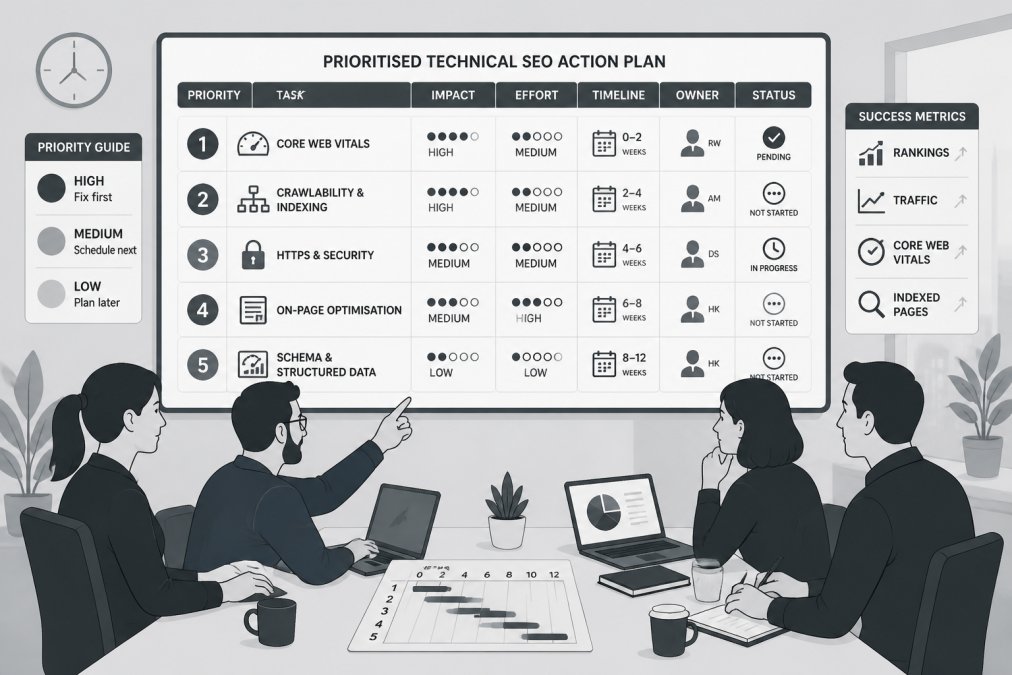
A typical implementation roadmap divides fixes into three tiers:
Tier 1: Critical (implement immediately). These are blocking issues that prevent indexation or severely damage user experience: fixing 404 errors on high-traffic pages, implementing HTTPS if you're still on HTTP, repairing broken internal links on your homepage. Most teams complete Tier 1 within 2-4 weeks.
Tier 2: High-impact (implement within 1-2 months). These fixes improve rankings or user experience but aren't blocking: optimising images for Core Web Vitals, implementing schema markup, improving page speed, fixing duplicate content. Tier 2 typically requires 40-80 hours of development time.
Tier 3: Long-term (implement over 3-6 months). These are optimisations that compound over time: restructuring internal linking for better crawl budget allocation, improving site architecture, implementing advanced caching strategies. Tier 3 work is often done alongside other development projects.
The key is consistency. Assigning responsibility for each fix, setting deadlines, and tracking completion prevents recommendations from being forgotten. Many SMEs benefit from quarterly check-ins: re-run your audit tool, compare results to the previous quarter, and celebrate progress.
YorkSoft Ltd can help you develop and execute this roadmap. Beyond the initial audit, ongoing technical SEO support ensures your site remains healthy as you add pages, update content, and deploy new features. This is where many SMEs see the biggest long-term gains, not from a one-time audit, but from treating technical SEO as an ongoing practice.
Technical SEO audit services for SMEs aren't a luxury; they're foundational to organic visibility. The businesses that outrank their competitors aren't always the ones with the best content or the most backlinks. They're the ones with solid technical foundations. If your site has crawlability issues, slow page speed, or missing schema markup, you're handing rankings to competitors who've fixed these problems. YorkSoft Ltd specialises in identifying these issues and building implementation roadmaps tailored to your team's capacity. Contact YorkSoft Ltd today | /contact and transform your technical SEO from a liability into a competitive advantage.
A technical SEO audit examines crawlability, indexation, site speed, Core Web Vitals, mobile responsiveness, SSL certificates, structured data, redirects, and broken links. It identifies issues preventing search engines from crawling and ranking your site effectively. The audit produces a prioritised list of fixes based on impact to your organic visibility and user experience.
Most SMEs benefit from a comprehensive audit annually or after major website changes. If you've migrated platforms, launched new sections, or noticed ranking drops, conduct an audit immediately. Quarterly spot-checks using automated tools help catch emerging issues like crawl errors or Core Web Vitals degradation between full audits.
You can use free or affordable tools like Screaming Frog (£199 per year) or Semrush to run a basic audit. However, professional services add interpretation, prioritisation, and implementation guidance. DIY suits SMEs with technical teams; professional audits work better when you lack in-house expertise or need a strategic roadmap aligned with business goals.
Common issues include slow page load times, poor Core Web Vitals scores, missing or incorrect canonical tags, duplicate content, broken internal links, unoptimised mobile experiences, missing schema markup, and crawl budget waste on low-value pages. Many SMEs also struggle with XML sitemaps, robots.txt configuration, and HTTP status code errors that block indexation.
A quality audit delivers a prioritised roadmap with estimated impact per fix, clear explanations of why issues matter, and actionable steps your team can implement. Look for services that provide ongoing support or at least a clear handoff process. YorkSoft offers tailored audits with implementation guidance designed specifically for SME budgets and technical capacity.