Aug 20, 2026 by Anthony York (YorkSoft Ltd)
Last Updated: August 20, 2026
Answer Engine Optimisation (AEO) is the practice of structuring and optimising your online content so that artificial intelligence systems, like ChatGPT, Google's AI Overviews, and voice assistants, can easily find, understand, and cite your information as authoritative. Unlike traditional SEO, which optimises for search engine rankings, AEO focuses on making your content clear, structured, and trustworthy enough that AI systems present it directly to users as a credible answer.
Around 36% of UK internet users are now turning to AI for online searches, according to Artemis Marketing's 2025 research. This shift is fundamental. When someone asks ChatGPT a question about your industry, your content either appears as a cited source or it doesn't. There's no ranking list, no "position three", you're either there or invisible.
For businesses in Northampton and across the UK, this represents a critical gap. Most companies have spent years optimising for Google's traditional search results. AEO requires a different approach: clearer content structure, better use of schema markup, and a focus on being the source AI systems want to quote. The businesses that get this right now will dominate AI-powered search results for years to come.
The confusion between AEO and SEO is understandable. They're related, but they solve different problems.
SEO optimises your website to rank higher in traditional search engine results pages. You're competing for position one, two, three. The user clicks your link, lands on your page, and reads your content. It's been the dominant strategy for two decades.
AEO optimises your content to be cited and quoted directly by AI systems. The user asks a question, and the AI reads multiple sources, including yours, then synthesises an answer. Your brand gets credited as a source, but the user may never visit your website. Some users will click through; others won't need to.
Here's where it gets interesting: AEO doesn't replace SEO. The two work together. A website that ranks well in Google AND is cited by AI systems captures more visibility than one that does either alone. According to research from The SEO Works, a UK-based AEO specialist, 93% of their clients are already appearing in AI overviews, but many of them didn't intentionally optimise for it. They simply had strong SEO foundations and clear content structure.
For Northampton businesses competing in crowded markets, this overlap is crucial. You need both traditional rankings and AI citability. The mistake most companies make is treating them as separate strategies. They're not. A well-structured piece of content that answers a question clearly will perform better in both traditional search and AI systems.
The real difference comes down to intent. SEO asks: "How do I get the user to my website?" AEO asks: "How do I become the source the AI trusts enough to quote?"
Optimising for AI systems requires a shift in how you think about content. You're not writing for a ranking algorithm anymore; you're writing for clarity and trustworthiness.
Start with structure. AI systems parse content differently than human readers. They look for clear definitions, logical hierarchies, and schema markup that tells them what information matters. If your content is buried in long paragraphs without headings, subheadings, or definitions, AI systems struggle to extract meaningful answers.
Use definitions early and often. When you introduce a concept, define it in a single, clear sentence. "AEO is the process of optimising content for AI-powered search systems." That sentence can be quoted directly. Bury the same definition in a paragraph, and the AI might miss it or extract a confusing fragment.
Schema markup is non-negotiable. This is structured data that tells AI systems exactly what your content is about. For a product page, schema markup clarifies the price, availability, and reviews. For an article, it clarifies the publication date, author, and key topics. Without schema markup, AI systems have to guess. With it, they extract information with confidence. Implement FAQ schema for question-and-answer content, Article schema for blog posts, and Product schema for e-commerce pages.
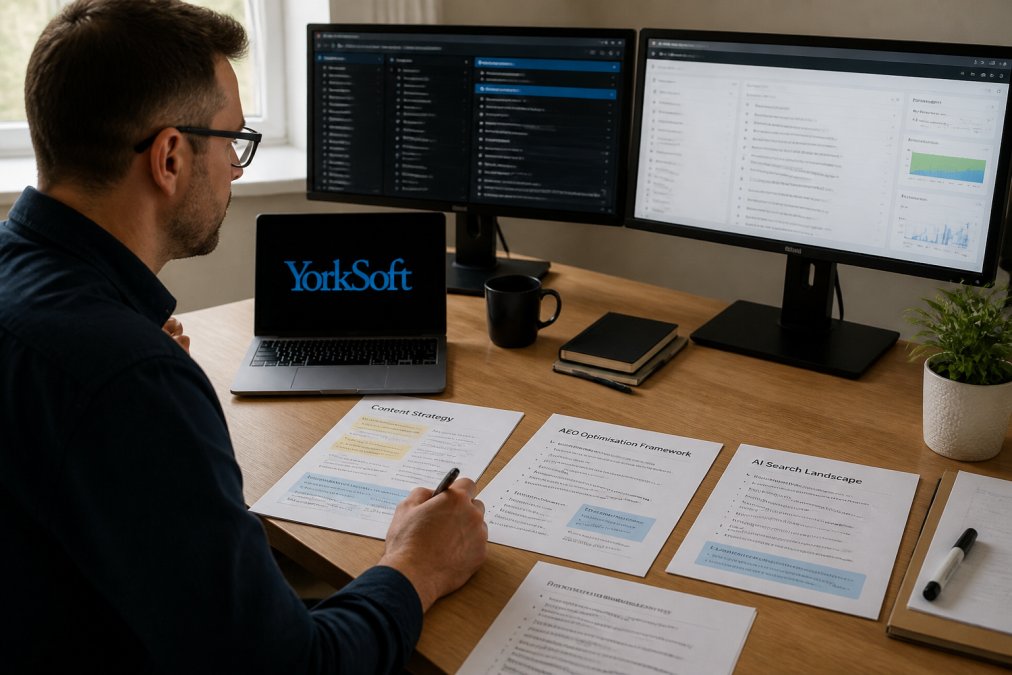
Content clarity matters more than keyword density. AI systems understand context and meaning far better than traditional search algorithms. Write for a human reader first. Answer their question completely. Use clear language, avoid jargon unless necessary, and provide examples. The keywords will follow naturally.
Test your content in AI systems. Ask ChatGPT, Google's AI Overviews, or Perplexity the same question you're optimising for. Does your content appear? If not, your content isn't structured in a way AI systems can extract and cite. Adjust your headings, definitions, and schema markup, then test again.
This is where many Northampton businesses struggle. They optimise for Google's traditional algorithm but never test their content in actual AI systems. The result is invisible content, content that ranks but never gets cited.
Northampton businesses have historically relied on local SEO, optimising for "plumber near me" or "accountant in Northampton" searches. That strategy still works, but AI systems are changing how local search works.
When someone in Northampton asks an AI system for a recommendation, "Which web development company should I use?", the AI might cite three local providers. But it doesn't list them like Google does. Instead, it synthesises information from multiple sources and recommends the one with the strongest online presence and clearest content structure.
This is a massive opportunity for Northampton businesses. If you're the clearest, most trustworthy source on your topic locally, AI systems will cite you. You don't need to rank first on Google anymore; you need to be the source AI systems trust.
Local schema markup becomes critical here. Mark up your business information, address, phone number, hours, service area, so AI systems know you serve Northampton. Create location-specific content that addresses questions your local customers ask. A Northampton accountancy firm might create content titled "How Self-Assessment Tax Works for Northampton Freelancers." That specificity signals to AI systems that this content is locally relevant and authoritative.
The businesses winning in local search right now are those treating AEO as a local strategy. They're not just optimising for "accountant" or "web developer", they're optimising for "what problems do my local customers have, and how do I answer those questions so clearly that AI systems cite me?"
YorkSoft Ltd can help businesses implement this approach. By combining AEO strategies with traditional local SEO, businesses can see increases in both traditional rankings and AI visibility. If you're a Northampton business looking to dominate your market, this dual approach is where the competitive advantage lies.
The benefits of AEO extend far beyond appearing in AI overviews. They reshape how your business is perceived online.
Increased brand authority. When AI systems cite your content, they're essentially endorsing it as trustworthy. This is more powerful than a ranking. A ranking says "Google thinks this is relevant." A citation says "This is the source we trust enough to quote directly." For Northampton businesses competing against national brands, that distinction is critical.
Direct traffic and indirect traffic. Some users who see your content cited in an AI overview will click through to your website. Others won't need to, they got their answer from the AI. But those citations build brand recognition. The user remembers your company name. When they're ready to buy, they search for you directly.
Reduced dependence on paid search. If your content appears consistently in AI overviews, you're getting free visibility. You're not paying per click like you would with Google Ads. This is especially valuable for Northampton SMEs operating on tight marketing budgets.
Competitive advantage. Most businesses still don't understand AEO. They're optimising for traditional search while ignoring AI systems entirely. The businesses that implement AEO now will dominate their markets for years. By the time competitors catch up, you'll have built an insurmountable lead in brand authority.
Future-proofing your strategy. AI-powered search is growing. According to Conductor's 2026 benchmarking research, AI referral traffic currently represents just over 1% of total web visits but is growing by roughly 1% each month on average. In two years, that could be 10-15% of your traffic. In five years, it could be 50%. Businesses that start optimising for AEO now will be positioned to capture that traffic when it arrives.
Starting with AEO doesn't require a complete website overhaul. You can begin with your highest-value content and expand from there.
Step 1: Audit your top content. Identify your ten highest-traffic pages or most important topics. These are your candidates for AEO optimisation. If a page already ranks well in Google, it's a strong foundation for AEO work.
Step 2: Test in AI systems. For each page, ask ChatGPT, Google's AI Overviews, and Perplexity the question your page answers. Does your content appear? If not, note what content does appear. You're looking for patterns, what structure and clarity do the cited sources have that yours lacks?
Step 3: Restructure for clarity. Add clear headings and subheadings. Write a definition paragraph early in your content. Use bullet lists to break up long explanations. Add schema markup. The goal is to make it trivially easy for an AI system to extract a complete, standalone answer from your content.
Step 4: Implement schema markup. This is technical work, but it's essential. Use FAQ schema for Q&A content, Article schema for blog posts, and Product schema for e-commerce pages. If you're not comfortable implementing schema yourself, tools like Yoast or Rank Math can help. If you need custom implementation, YorkSoft Ltd specialises in technical SEO and schema optimisation for UK businesses, worth contacting if you want professional setup.

Step 5: Create new content with AEO in mind. Going forward, write every new piece of content with AI systems in mind. Structure it clearly. Define key terms. Use headings generously. Include schema markup from the start. This becomes your new standard, not an exception.
Step 6: Monitor and iterate. Check your content in AI systems monthly. Are you appearing in more overviews? Are you being cited more frequently? If not, adjust your structure, clarity, or schema markup. AEO is iterative, you learn by testing and refining.
| Step | Focus | Frequency |
|---|---|---|
| Audit | Identify high-value content | Once, then quarterly |
| Test | Check AI system visibility | Monthly |
| Restructure | Improve clarity and schema | Ongoing |
| Implement | Add structured data | Per piece of content |
| Create | Write new content with AEO | Every new article |
| Monitor | Track AI citations | Monthly |
The timeline for seeing results varies. Some content appears in AI overviews within weeks of optimisation. Other content takes months. The important thing is consistency. Optimise systematically, test regularly, and refine based on results.
For Northampton businesses without in-house technical expertise, this is where professional support makes a difference. YorkSoft Ltd can handle the technical implementation, schema markup, structured data, content architecture, while you focus on content quality. Their rank monitoring and AI analysis tools help you track what's working and adjust strategy accordingly.
AEO isn't a replacement for SEO or traditional marketing. It's an evolution. The businesses that understand this now, that treat AEO as a core strategy rather than a nice-to-have, will capture disproportionate visibility in AI-powered search results. For Northampton businesses competing against larger regional and national players, this is your competitive advantage. Start with your best content, structure it for clarity, and let AI systems do the work of spreading your message. If you're ready to implement AEO properly, YorkSoft Ltd can help you build the technical foundation and track your progress. Call us Now to discuss how AEO can transform your online visibility.
SEO optimises content for traditional search engine rankings, focusing on keywords and backlinks. AEO optimises content for AI-powered search engines and direct answer formats like Google's AI Overviews and ChatGPT. While SEO aims for high rankings in search results lists, AEO ensures your content is cited as a trusted source directly within AI responses. Both are essential: around 36% of UK internet users now turn to AI for searches, making AEO increasingly critical for visibility.
AEO improves visibility by ensuring your content is clear, structured, and trustworthy enough for AI systems to cite. This includes using FAQ formats, schema markup, natural language, and entity linking. When AI systems present your content as an answer, you gain direct visibility without relying solely on click-through from a search results page. Studies show 93% of clients working with AEO-focused agencies already appear in AI overviews, significantly boosting brand authority.
Absolutely. AEO is particularly valuable for SMEs because it levels the playing field. While larger competitors may dominate traditional search rankings, AEO focuses on content quality and relevance rather than domain authority alone. Small businesses that optimise for AI search can compete directly for visibility in AI overviews. SMEs account for 90% of businesses worldwide and 36% of exports in developed economies, AEO helps them reach global audiences through AI-powered discovery.
AI analysis tracks how often your content appears in AI overviews, which AI tools cite you as a source, and how your visibility compares to competitors. Unlike traditional SEO tools, AI monitoring measures direct answer visibility, a metric that's increasingly important as AI referral traffic grows. This helps you understand which content resonates with AI systems and where to focus optimisation efforts. YorkSoft's AI analysis identifies opportunities to boost your authority in AI search results, directly supporting your digital strategy.