Jul 26, 2026 by Anthony York (YorkSoft Ltd)
Last Updated: July 26, 2026
Understanding bespoke membership website development cost requires looking beyond initial build fees. At YorkSoft Ltd, we've analysed hundreds of membership platform projects across the UK, and the reality is that most organisations underestimate the true investment required. The difference between a £40,000 custom build and a £200,000+ implementation often comes down to scope, integrations, and what happens after launch.
Membership website development cost varies dramatically based on feature complexity, integration requirements, and your target audience size. A simple WordPress plugin approach costs significantly less than a fully custom-built platform, but custom solutions offer capabilities that off-the-shelf tools cannot match.
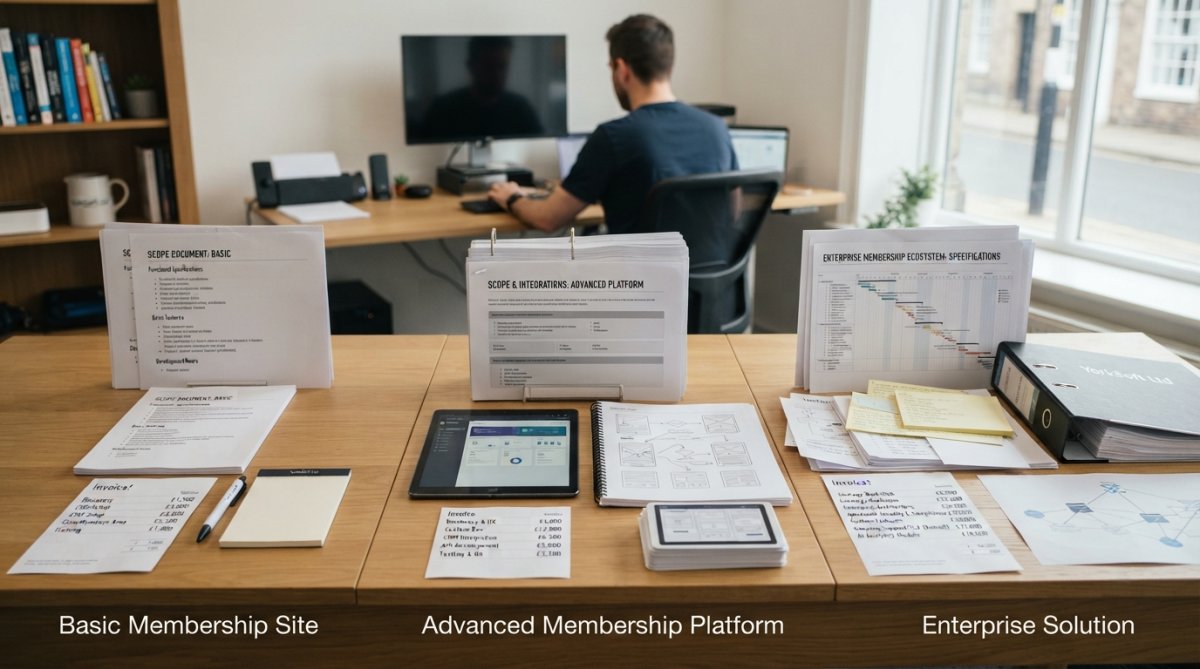
The scope of custom functionality is the single largest cost driver. A basic membership site with user registration, content restriction, and payment processing might cost between £40,000 and £80,000. Adding tiered membership levels, automated email workflows, advanced reporting, or member-to-member networking features climbs costs rapidly.
Custom development means building exactly what your organisation needs. If your members require a sophisticated portal where they can manage subscriptions, download resources, track attendance, and interact with other members, you're looking at substantially more complex database architecture. Each additional feature typically adds 15-25% to the development timeline and cost.
According to Steadfast Collective's membership platform insights, organisations that invest in bespoke development often see 3-4x better member retention than those using template solutions.
Most membership organisations integrate with payment gateways, CRM systems, email marketing platforms, accounting software, or conferencing tools. Each integration adds complexity and cost.
A simple Stripe or PayPal integration might add £2,000-£5,000. Integrating with Salesforce CRM, Mailchimp for marketing automation, and Zoom for virtual events adds weeks of development work. Data migration from legacy systems can cost £5,000-£20,000 depending on data volume and quality.
The choice between bespoke development and off-the-shelf platforms fundamentally shapes your cost structure and long-term total cost of ownership.
Bespoke membership website development cost is justified when your organisation has unique requirements that template solutions cannot meet. Professional associations with complex member tiers, credentialing requirements, and external verification system integration typically require custom builds.
Organisations with 5,000+ members, complex revenue models, or sophisticated member engagement requirements typically find bespoke solutions deliver better ROI within 3-5 years. The initial investment is higher, often £80,000-£250,000, but optimising every aspect of the member experience drives superior retention and revenue. Custom solutions also protect you from platform lock-in, giving you more flexibility to evolve without rebuilding.
Template-based membership platforms offer lower initial costs, typically £5,000-£30,000 for implementation. However, the "lower cost" narrative breaks down once you factor in transaction fees (often 2-5% per membership payment), ongoing subscription costs for premium features, and plugin fees.
Understanding what each major feature costs helps you build a realistic budget and prioritise ruthlessly.
User authentication systems, login, password reset, two-factor authentication, and session management form the foundation of any membership site. A basic authentication system costs £3,000-£8,000. A sophisticated member portal where users manage profiles, view transaction history, update payment methods, and download resources adds £8,000-£15,000.
Advanced authentication features like single sign-on (SSO) integration, social login, or passwordless authentication add £5,000-£10,000 and significantly improve login completion rates.
Payment processing integration is essential. Stripe, PayPal, and GoCardless are the most common UK options. Basic integration costs £2,000-£5,000; supporting multiple payment methods, subscription renewals, and failed payment management adds complexity.
Tiered membership levels, where different member types have different access levels and pricing, require sophisticated logic managing different content access rules, pricing schedules, and renewal cycles. This typically costs £6,000-£12,000. Recurring billing management is essential for reducing involuntary churn.
CRM integration, syncing member data with systems like Salesforce, HubSpot, or Pipedrive, allows your teams to see member activity without logging into a separate system. Basic CRM integration costs £5,000-£10,000. More sophisticated integration where membership changes trigger automated workflows costs £10,000-£20,000.
Data management infrastructure is often overlooked. Building strong database architecture, backup systems, and secure storage adds £3,000-£8,000 but is essential for protecting member information.

The development phase is just the beginning. Most organisations spend 30-50% of their initial investment annually on hosting, maintenance, support, and compliance work.
Hosting costs depend on your member base size and traffic patterns. A modest membership site (under 10,000 members) typically costs £100-£300/month for managed hosting. Larger sites with 50,000+ members might cost £500-£2,000+/month.
SSL certificates (the security protocol enabling HTTPS) are essential for membership sites handling payment and personal data. Basic SSL certificates cost £50-£200/year; extended validation certificates cost £200-£500/year.
Ongoing maintenance, updating plugins, applying security patches, fixing bugs, and optimising performance costs £500-£2,000/month depending on platform complexity. This is often bundled as a support contract with your development agency.
Technical support availability matters. Database optimisation and performance tuning become necessary as your member base grows, costing £200-£500/month.
Security is non-negotiable for membership sites handling payment data and personal information. Regular security audits, penetration testing, and vulnerability remediation cost £2,000-£5,000 annually.
Compliance work, ensuring your site meets GDPR requirements, accessibility standards (WCAG), and payment card industry (PCI) standards, requires ongoing attention. Data protection impact assessments, privacy policy updates, and compliance audits cost £1,000-£3,000 annually.
WordPress dominates the UK membership space. Understanding the cost trade-offs between plugin-based and custom WordPress development helps you make the right choice.
WordPress plugins offer rapid deployment and lower upfront costs. Setup and configuration typically cost £2,000-£8,000. However, plugin performance degrades as your member base grows. A plugin handling 500 members might struggle with 5,000. Each additional plugin adds overhead and database queries.
Custom WordPress development, building membership functionality tailored to your organisation, costs more upfront (£40,000-£100,000+) but offers superior flexibility and performance. You're building only what you need, avoiding plugin bloat.
Custom WordPress development creates faster, more responsive member experiences. Custom-built membership sites consistently outperform plugin-based sites on performance metrics, loading 30-50% faster and handling traffic spikes more gracefully. The trade-off is maintenance complexity, requiring an ongoing support contract with familiar developers.
Agency costs vary dramatically based on experience, location, and project complexity. Understanding what you're paying for helps you evaluate proposals fairly.
UK web development agencies typically charge £50-£150/hour for standard development work. Senior developers and specialists charge £100-£200+/hour. Project-based pricing, where you pay a fixed fee for defined scope, is more common for membership sites, typically ranging from £50,000 to £250,000+ depending on complexity, features, and integrations.
Agencies often structure projects in phases: discovery (2-4 weeks), design (4-6 weeks), development (8-16 weeks), and testing/launch (2-4 weeks).
An agency specialising in membership platforms will deliver faster, better results than a generalist agency. Specialisation matters because membership sites have unique requirements: recurring billing, member authentication, content access control, and community features.
Ask prospective agencies for case studies of similar projects. Check references carefully and ask about post-launch support, performance, and whether final costs matched estimates.
YorkSoft Ltd specialises in bespoke web development and custom applications. When evaluating YorkSoft for your membership project, ask about their experience with similar member bases, their approach to security and compliance, and their post-launch support model. Understanding how an agency handles ongoing maintenance and support is as important as their development capabilities. Contact YorkSoft Ltd to discuss your membership website requirements and get a realistic assessment of investment needed for your specific situation.
Evaluating bespoke membership website development cost requires thinking beyond the initial build. A five-year total cost of ownership (TCO) model reveals the true investment.
Every codebase accumulates technical debt, shortcuts taken during initial development that require refactoring later. A well-built membership site might require 20-30% refactoring work within 3-5 years as requirements evolve.
Budget £5,000-£15,000 annually for refactoring and technical debt reduction. Performance optimisation becomes necessary as your member base grows, preventing member experience degradation.
Your internal team needs training to effectively manage and evolve your membership site. Budget £2,000-£5,000 for initial training and documentation. Ongoing training as your team grows adds £1,000-£3,000 annually.
Consider allocating internal resources for ongoing product management. Someone on your team should own the member experience roadmap, prioritise feature requests, and manage the relationship with your development partner.
| Cost Category | Year 1 | Year 2-3 (annual) | Year 4-5 (annual) |
|---|---|---|---|
| Initial Development | £60,000-£150,000 | , | , |
| Hosting & Infrastructure | £2,000-£5,000 | £2,000-£5,000 | £2,500-£6,000 |
| Maintenance & Support | £6,000-£24,000 | £6,000-£24,000 | £8,000-£30,000 |
| Security & Compliance | £2,000-£5,000 | £2,000-£5,000 | £3,000-£6,000 |
| Technical Debt/Refactoring | , | £5,000-£15,000 | £8,000-£20,000 |
| Team Training | £2,000-£5,000 | £1,000-£3,000 | £1,000-£3,000 |
Operating a membership site in the UK means complying with data protection, accessibility, and payment processing regulations. These requirements add cost but are non-negotiable.
GDPR compliance isn't a one-time cost. Your site must implement data protection by design, provide members with data export capabilities, handle data deletion requests, and maintain audit logs. Initial GDPR implementation costs £3,000-£8,000; ongoing compliance work costs £500-£1,500 annually.
Accessibility compliance under the Public Sector Bodies Accessibility Regulations requires your site to meet WCAG 2.1 AA standards. Retrofitting accessibility into an existing site costs £5,000-£15,000; building accessibility in from the start costs less.
According to UK Information Commissioner's Office guidance on membership data, organisations managing member data must conduct data protection impact assessments, document their legal basis for processing, and implement appropriate security measures. This documentation and assessment work costs £1,000-£3,000 initially and requires annual review.
If you're migrating members from a legacy system, budget £5,000-£20,000 for data extraction, transformation, validation, and import. Member onboarding to the new platform requires communication and support. Budget £2,000-£5,000 for onboarding materials, email campaigns, and support during the transition period.
Bespoke membership website development cost is a significant investment in member experience, organisational efficiency, and revenue growth. The organisations that see the best returns approach it strategically: understanding their unique requirements, choosing the right development partner, and budgeting for ongoing evolution and compliance.
When evaluating development partners, YorkSoft Ltd brings specialised expertise in custom web applications and digital solutions. Their approach to technical excellence ensures your membership platform delivers real business value.
Bespoke membership website development cost depends on multiple factors: custom functionality and feature complexity, integration requirements with CRM or payment systems, UX/UI design depth, user authentication systems, database management, hosting infrastructure, and compliance needs such as GDPR. The scale of your member base, tiered membership levels, and API development requirements also significantly impact the final cost. Each organisation's unique requirements mean pricing varies considerably.
WordPress membership site cost in the UK using plugins like MemberPress or Paid Memberships Pro typically involves annual licensing fees plus hosting costs, starting from around £142-£275 per year. However, these solutions may require additional custom development for unique features, and scaling can become expensive. Bespoke development requires higher upfront investment but offers unlimited customisation, better scalability, and often lower long-term costs when considering technical debt and feature restrictions of templates.
Ongoing membership website costs in the UK include hosting infrastructure, SSL certificates, maintenance contracts, technical support, security patches, and compliance updates. You'll also need to budget for plugin or software licensing fees, CRM integration maintenance, and potential refactoring as your platform grows. Team training and internal resource allocation for day-to-day management are often overlooked but represent significant long-term expenses that should be included in your total cost of ownership calculation.
Choose bespoke development if your organisation has unique member management needs, complex integrations, specific compliance requirements, or plans for significant growth and feature expansion. Off-the-shelf solutions work well for straightforward use cases with standard features. However, template limitations often lead to hidden costs in workarounds and custom development anyway. Consider your 3-5 year total cost of ownership, scalability needs, and whether vendor lock-in poses a risk to your business before deciding.
UK membership websites must comply with GDPR, which impacts data handling, user consent, and member privacy features. Accessibility standards (WCAG 2.1) are increasingly important for inclusive design. SSL certificates ensure secure data transmission. Budget for initial compliance implementation during development and ongoing audits. Data migration from legacy systems, onboarding processes for members, and regular security updates all carry compliance-related costs. These are often underestimated but essential to avoid regulatory penalties.