
Oct 02, 2026 by Anthony York (YorkSoft Ltd)
Last Updated: October 1, 2026
Only 4% of companies have successfully achieved fully automated workflows, according to 2026 business automation research. That statistic alone tells you something important: challenges of implementing business process automation aren't edge cases. They're the norm.
Most organisations fail not because the technology is broken, but because they approach automation with the wrong expectations. They pick tools first, skip the planning phase, and hope for the best. By the time they realise something's gone wrong, they've already spent months and significant resources on the wrong processes.
At YorkSoft Ltd, we've seen this pattern repeat across businesses in the Northampton area. The teams that succeed aren't the ones with the biggest budgets. They're the ones that understand where automation actually fails, and plan accordingly.
This guide covers the real obstacles you'll face when implementing business process automation, and what you can do about them. We'll walk through integration nightmares, change management pitfalls, process selection errors, and the regulatory landscape that catches most organisations off guard.
Integration complexity is the leading challenge for enterprise operations in 2026, particularly when incorporating new technologies like machine learning and robotic process automation into existing legacy systems, according to an analysis of business automation trends.
Your existing systems weren't built to talk to each other. Your ERP system runs on infrastructure from 2015. Your CRM is cloud-based. Your accounting software is entirely separate. When you try to connect them through automation, you're asking incompatible systems to work as one.
The problem compounds when you add modern tools into the mix. Legacy systems use outdated APIs or no APIs at all. Data formats don't match. Authentication methods conflict. What should take weeks takes months because your technical team is building custom bridges between systems that were never designed to integrate.
What makes this worse:
The fix requires honest assessment. Before you implement any automation, map your entire technology stack. Document which systems must communicate with each other. Identify which integrations already exist and which ones you're building from scratch. This isn't glamorous work, but it's the difference between a project that runs smoothly and one that stalls for six months.
For businesses around Northampton managing complex legacy environments, working with specialists who understand both old infrastructure and modern automation tools makes this phase significantly faster. YorkSoft Ltd has experience building custom web applications that bridge legacy systems and modern workflows.
Employee fear of job loss remains a significant implementation challenge, with 37% of professionals expressing concern that automation will lead to redundancy, according to 2026 business automation statistics. But the real problem isn't the fear itself, it's that most organisations ignore it entirely.
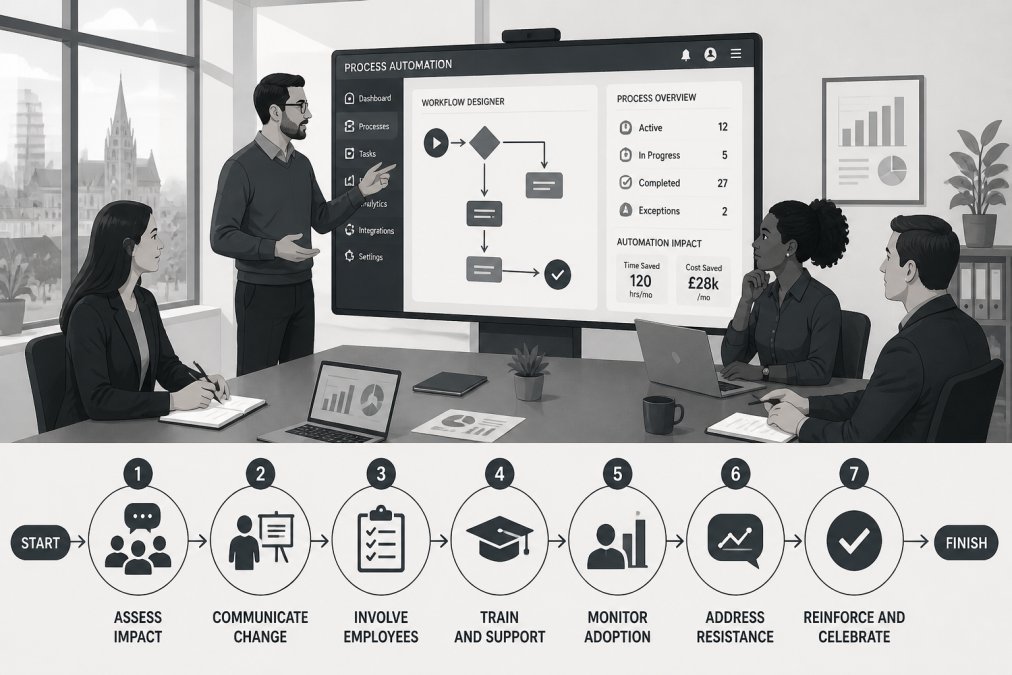
Your employees didn't sign up for uncertainty. They built expertise around the current process. Now you're telling them a system will do their job faster, and they're supposed to be excited about retraining.
This is where weak change management becomes your biggest enemy. According to research analysing automation challenges, weak change management is the top barrier to successful BPA projects. It's followed by insufficient training (cited by 31% of organisations) and choosing the wrong processes to automate (28%).
Why change management fails:
The solution requires transparency and involvement. Start change management before you implement anything. Bring employees into the conversation early. Show them how automation removes tedious work so they can focus on higher-value tasks. Be honest about role changes. Invest in proper training, not a one-off session, but ongoing support.
When you're planning automation in your organisation, involve the people doing the work. They understand the process better than anyone. They'll identify edge cases and bottlenecks that management misses. They'll also become your advocates instead of your resistors.
Poor process selection is consistently identified as a primary cause of automation project failure. Many organisations automate processes that shouldn't be automated, or skip processes that would deliver the biggest return.
The mistake usually comes from one of two directions. Either leadership picks processes based on what seems impressive (automating something visible to customers) or based on what's easiest to automate (processes that are already well-documented and straightforward). Neither approach delivers real value.
The right process to automate is one that meets specific criteria:
Criteria | Why It Matters | Red Flag |
|---|---|---|
High volume | Automation saves time on repetitive work | Automating a quarterly task wastes resources |
Well-defined | Clear rules and exceptions reduce complexity | Processes requiring constant judgement fail automation |
Rule-based | Automation handles logic, not exceptions | Processes requiring human discretion stall automation |
Measurable impact | You can prove the investment paid off | Automating for visibility instead of efficiency |
Stable | The process won't change significantly soon | Automating processes you're redesigning next quarter |
Before you automate anything, audit your processes. Document how work actually flows (not how you think it flows). Identify bottlenecks. Calculate the time spent on each process. Then rank them by impact: which processes, if automated, would free up the most staff time or eliminate the most errors?
Start with one process. Make it successful.
For small businesses, choosing the right automation tools means balancing capability with complexity. You don't need enterprise-grade systems. You need tools that solve specific problems without requiring a dedicated IT team to manage them.
What to look for:
Successful automation projects follow a consistent pattern. They start with clear goals, involve the right people, test thoroughly, and measure results continuously.
The implementation roadmap:
When you automate processes involving personal data, you're moving sensitive information through systems that weren't originally designed to handle it. That's where security and compliance become critical.
Key compliance considerations:
The challenges of implementing business process automation are real, but they're not insurmountable. The organisations that succeed are the ones that plan carefully, involve their teams, start small, and measure results.
The primary reason is weak change management, cited as the top challenge for automation projects. Additionally, 28% of organisations automate the wrong processes, whilst 63% experience implementation delays and 37% face unexpected costs. Poor process selection, combined with insufficient training (31% of cases) and inadequate risk management planning, creates a compounding effect that derails projects before they deliver value.
Integration complexity represents the leading challenge, particularly when incorporating new technologies like machine learning and RPA into existing legacy systems. For small businesses, the lack of internal technical expertise compounds this problem. Additionally, employee fear of job loss affects 37% of professionals, making change adoption difficult. Many SMEs also struggle with selecting which processes to automate, leading to wasted resources on low-impact automation efforts.
Compliance requires a structured approach that incorporates data governance from the project's outset. Under UK GDPR, organisations must conduct Data Protection Impact Assessments (DPIAs) before deploying automation affecting personal data. Ensure your automation platform encrypts data in transit and at rest, maintains audit trails, and supports data subject rights like access and deletion. Work with providers who understand UK data protection obligations and can demonstrate how their systems handle sensitive information securely.
Only 4% of companies have achieved fully automated workflows, highlighting how challenging end-to-end automation remains. This statistic underscores why a phased approach, starting with high-impact, low-complexity processes, delivers better results than attempting comprehensive automation overnight. Most organisations benefit from focusing on specific pain points first, building internal capability, and scaling gradually.
Ready to overcome automation challenges? Contact YorkSoft Ltd for a consultation on business process automation and discover how custom solutions can streamline your workflows while maintaining security and compliance.