Aug 18, 2026 by Anthony York (YorkSoft Ltd)
Last Updated: August 18, 2026
The UK custom software development market generated £1.6 billion in revenue during 2025 and is projected to reach £5.3 billion by 2033, according to Grand View Research's 2026 UK custom software market analysis. This growth reflects a fundamental shift: small and medium-sized enterprises are moving beyond spreadsheets and off-the-shelf tools to invest in bespoke solutions tailored to their specific workflows.
At YorkSoft Ltd, we've tracked this transition closely across Northampton and beyond. Custom software automation costs depend on complexity, integration scope, and ongoing support needs. According to Federation of Small Businesses and Equity IT's 2025 automation impact study, SMEs adopting automation are 2.5 times more likely to report year-on-year revenue growth compared to those relying solely on manual processes.
Below, we'll break down the cost factors, compare approaches, and show you how to evaluate whether custom automation makes financial sense for your business.
The cost of custom software automation for SMEs varies dramatically based on what you're trying to automate.
Simple automation typically involves connecting two or three systems with minimal custom logic: automatically logging customer emails into a CRM, syncing order data to accounting software, or triggering notifications when specific conditions are met.
These projects use no-code or low-code platforms where configuration handles the heavy lifting. You're paying for setup, testing, and documentation, not building infrastructure from scratch.

Mid-range projects involve three or more systems, conditional logic, approval workflows, or partial AI integration. Examples include automating customer onboarding across CRM, billing, and project management platforms, or implementing AI-powered document classification.
According to HGC IT Solutions' 2026 time-savings analysis, SMEs can save 15-25 hours weekly per automated process, translating to £19,500 to £65,000 annually at typical UK labour costs.
Enterprise-grade systems are purpose-built platforms for your specific business model: custom member management systems for professional associations, bespoke inventory platforms for e-commerce retailers, or integrated financial forecasting tools for manufacturing.
The payoff is proportional to scope. A manufacturing business implementing custom production scheduling might reduce scheduling time from 40 hours weekly to 4 hours whilst improving on-time delivery by 15 percent.
According to research from TechUK and Equity IT (2025), companies using automation experience a 20 percent reduction in operational costs and a 15 percent increase in customer satisfaction.
Error reduction is significant. Manual data entry introduces mistakes: wrong customer records, duplicated orders, misclassified expenses. Automation eliminates the entry point entirely. If each error costs 30 minutes of rework time, automating data flow saves 10-25 hours weekly.
Consistency improves dramatically. Automated workflows enforce standardised processes. Every customer follows the same onboarding sequence. Every invoice goes through identical validation rules. This standardisation reduces variation, improves compliance, and simplifies staff training.
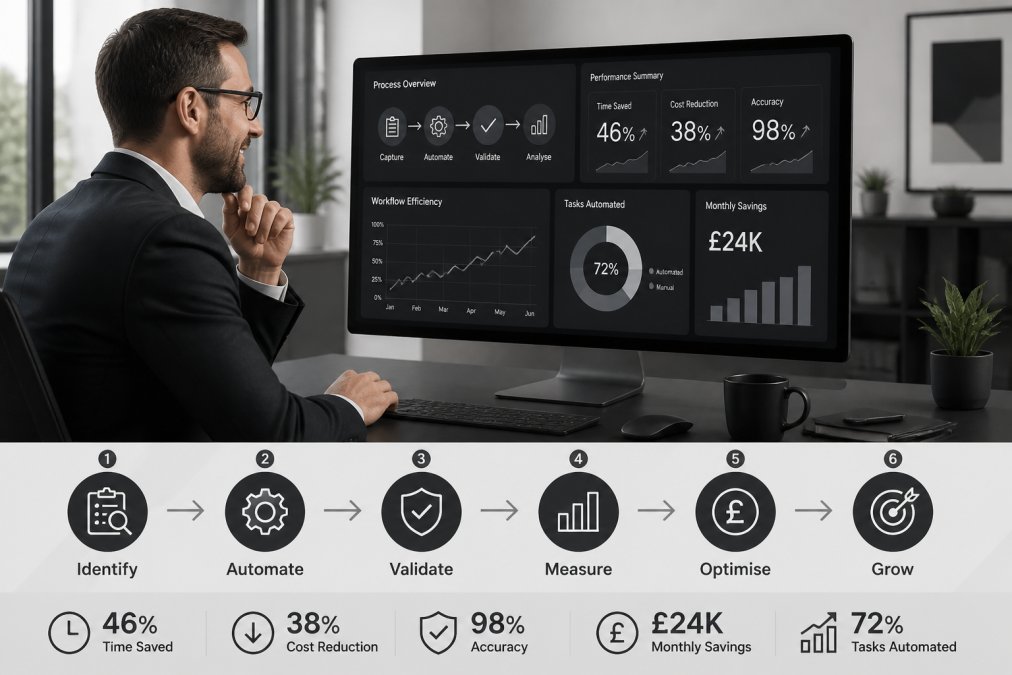
Staff satisfaction often increases. Automating repetitive tasks eliminates tedium. At Harrison Spinks, a Yorkshire-based manufacturer that implemented collaborative robotics and AI-driven quality control, production workers were retrained as 'Robot Supervisors' and 'Quality Analysts.' Productivity increased 40 percent whilst maintaining workforce size.
Scalability becomes possible without proportional cost increases. A business handling 100 customer orders daily might require one full-time order processor. Automating order entry, validation, and routing might let that person handle 500 daily orders.
Calculating ROI requires identifying both cost and benefit clearly. Start with time savings. If your team spends 20 hours weekly on a specific process and automation reduces that to 3 hours, you've freed 17 hours weekly. At £40 per hour loaded cost, that's £680 weekly or £35,360 annually. A development investment plus annual maintenance costs in year one. Your payback period is roughly 6 months.
This calculation assumes the freed time creates value, either through revenue-generating work or cost avoidance. The best automation projects are paired with clear plans for how freed capacity gets redeployed.
Error reduction compounds benefits. Cotswold Collections, a Bristol-based online retailer, implemented an AI-powered customer service platform with a customised chatbot. The chatbot now handles 67 percent of incoming queries, customer satisfaction scores increased 28 percent, and service costs decreased 32 percent.
Revenue impact is the highest-use benefit. A UK SaaS startup automated lead assignment and follow-up workflows. Lead response time reduced from 6 hours to 45 minutes. That single improvement increased conversion rates by 18 percent. The automation generated an additional £120,000 in annual recurring revenue.
The key is measuring impact before and after implementation. Set baseline metrics: hours spent weekly, error rate, customer satisfaction scores, conversion rates. Implement the automation. Measure the same metrics 30 days post-launch. Honest measurement separates projects that genuinely create value from those that shuffle work around.
Custom software automation costs vary because projects vary.
Scope defines what the system does. A simple order-entry automation that syncs data between two systems has narrow scope. A comprehensive member management platform for a professional association, handling membership renewals, event registration, billing, permissions, and reporting, has broad scope. Broader scope means more development time, more testing, more integration points.
Complexity describes how intricate the logic needs to be. A workflow that says "if order total exceeds £1,000, route to manager approval" is simple. A workflow that says "if order total exceeds threshold X (which varies by customer tier and region), and customer credit rating is above Y, and inventory is available in warehouse Z, then auto-approve and route to nearest fulfillment centre, otherwise escalate to manager with predictive delivery date" is complex.
Detailed requirements documentation before development begins is the best defence.
How many external systems does your automation need to connect with? A project that only talks to your internal database is simpler than one that integrates with your e-commerce platform, payment processor, shipping provider, accounting software, and CRM.
Each integration requires understanding that system's API, handling authentication, managing data transformations, and building error handling. A project with five integrations costs significantly more than a project with one.
Legacy systems are particularly expensive to integrate. If your accounting software is 15 years old and has no modern API, integration might require custom middleware. Cloud-native systems with well-documented APIs are the cheapest to integrate.
The initial build cost is only the beginning. Your software needs ongoing maintenance, monitoring, and support. Clarify the maintenance model before signing a development contract.
The custom versus off-the-shelf decision isn't purely about price. It's about fit, flexibility, and long-term cost of ownership.
Off-the-shelf software costs less upfront. A project management tool might cost £20-£100 monthly. An email marketing platform might cost £15-£300 monthly. You're buying access to existing functionality, not paying for development.
The trade-off is flexibility. Off-the-shelf software does what its creators designed it to do. If your business process doesn't match the software's assumptions, you have three options: change your process to fit the software, accept workarounds that create friction, or build custom integrations that partially bridge the gap.
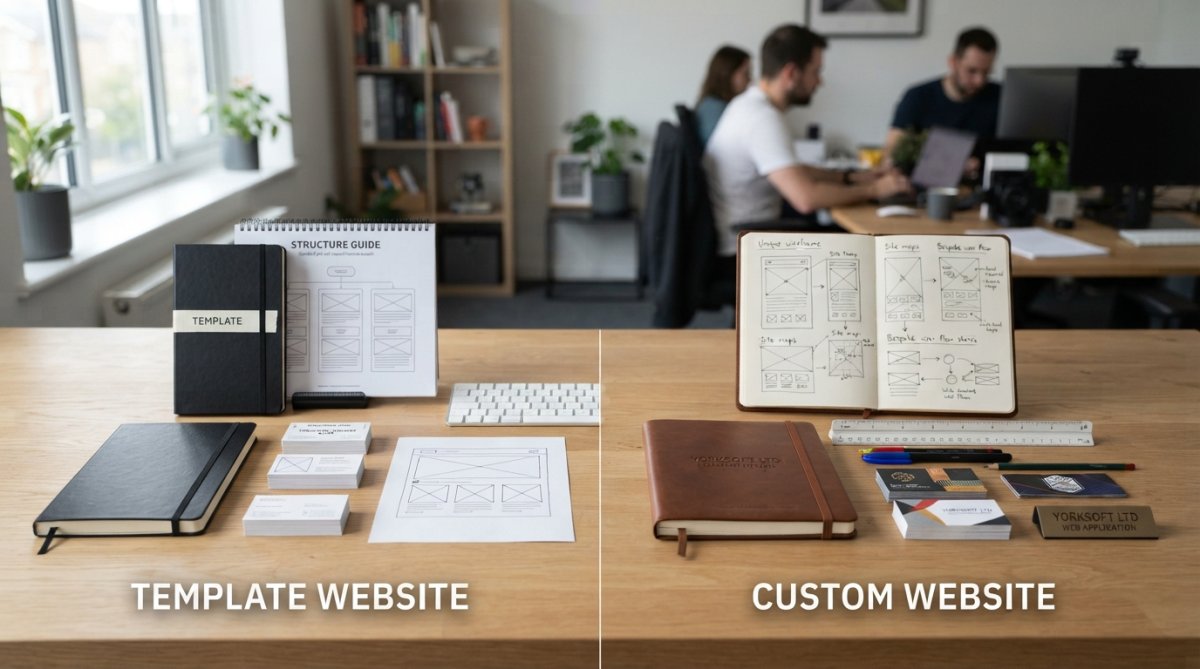
For standard business processes, off-the-shelf often makes sense. For unique business processes, your specific member management model, your particular manufacturing workflow, your distinctive customer onboarding sequence, custom development costs more upfront but eliminates the friction of forcing your business into someone else's box.
Consider total cost of ownership over five years. If the custom system eliminates 15 hours weekly of manual work (£35,000 annual benefit), the custom system breaks even in year one and generates £105,000 in five-year benefit.
| Approach | Upfront Cost | Monthly Cost | Customisation | Integration | Best For |
|---|---|---|---|---|---|
| Off-the-Shelf SaaS | £0-£2,000 | £20-£300 | Limited | Pre-built connectors | Standard processes, budget-conscious teams |
| Custom Development | Pricing depends on complexity | Pricing depends on complexity | Unlimited | Any system | Unique workflows, competitive advantage |
| Hybrid (Off-the-shelf + Custom Integration) | Pricing depends on complexity | Pricing depends on complexity | Moderate | Custom middleware | Partially unique processes, existing platform preference |
The development cost and maintenance cost aren't the only expenses you'll encounter.
Training and change management often gets underestimated. Staff need to learn the new system. Budget 5-10 percent of project cost for training.
Data migration can be surprisingly expensive. Moving data from your old system to the new one requires cleaning data quality issues: missing fields, duplicate entries, inconsistent formatting.
Infrastructure costs matter for self-hosted systems. Cloud hosting for a custom application might cost £500-£2,000 monthly depending on traffic and storage. Backup and disaster recovery add another £200-£500 monthly.
Customisation requests after launch are inevitable. Users discover workflows that don't quite work as expected. Budget 10-15 percent of the original development cost annually for post-launch customisations.
Technology obsolescence is a longer-term concern. The technology stack your system is built on eventually becomes outdated. Major technology updates might be required every 5-7 years.
The businesses that thrive are those that budget for maintenance, training, and periodic modernisation from the start.
Custom software automation for SMEs can range from simple single-workflow projects to enterprise-grade systems. The cost reflects the complexity of what you're building, the systems you're integrating with, and the expertise required.
According to SME Digital Adoption Taskforce Final Report from Entrepreneur UK (2026), approximately 54 percent of UK SMEs are actively adopting AI and automation. Those businesses are 2.5 times more likely to report revenue growth.
When evaluating a custom software automation project, start with clear baseline metrics. How many hours does your team spend on the process weekly? What's the error rate? What's the customer satisfaction impact? Calculate the annual benefit of eliminating that work. Compare that benefit to the cost of custom development plus maintenance. If payback occurs within 12-18 months and the system creates ongoing value, the investment makes sense.
YorkSoft Ltd helps businesses in Northampton and across the UK evaluate whether custom automation is the right choice for their specific workflows. Our approach starts with understanding your actual business problem, not the technology you think you need, but the outcome you're trying to achieve. From there, we determine whether custom development, off-the-shelf tools, or a hybrid approach delivers the best return on investment.
If you're considering custom software automation and want to discuss whether it makes financial sense for your business, contact YorkSoft Ltd to discuss your specific requirements | yorksoft.co.uk/contact. We'll help you quantify the benefit and build the right solution at the right cost.
Custom software automation costs vary by complexity. Simple, single-workflow automation using off-the-shelf tools ranges from £5,000-£10,000 one-off. Moderate projects with multiple systems and some AI integration cost £10,000-£25,000. Bespoke applications for small businesses typically span £25,000 to £120,000, while enterprise systems can exceed £150,000. Ongoing maintenance usually runs 15-20% of the build cost annually. The exact figure depends on your specific requirements, integrations needed, and the development approach you choose.
Key factors include project scope and complexity, number of systems requiring integration, whether you need custom AI components, timeline requirements, and the level of ongoing support needed. Integration with existing retail management systems, CRM platforms, or membership databases significantly affects cost. Custom features, real-time data synchronisation, and compliance requirements (such as data protection standards) also drive pricing. A development partner like YorkSoft can assess your specific needs and provide a clear cost estimate based on these factors.
Yes, when aligned with your business needs. UK SMEs using automation have seen 78% report measurable productivity improvements, with companies experiencing a 20% reduction in operational costs and 15% increase in customer satisfaction. SMEs adopting automation are 2.5 times more likely to report year-on-year revenue growth. A typical automated process saves 15-25 hours weekly, translating to £19,500-£65,000 annual savings. While upfront costs are significant, the long-term ROI typically justifies the investment, especially for businesses with repetitive, manual processes or specific integration needs that off-the-shelf tools cannot address.
Beyond the initial build cost, factor in annual maintenance (15-20% of development cost), staff training, data migration, system integration testing, and potential customisations post-launch. Some projects require additional costs for compliance, security audits, or API integrations. Implementation can take longer than expected, affecting business operations during transition. Choosing a development partner with transparent pricing and clear scope definition, like YorkSoft, helps avoid surprises. Always request a detailed breakdown of costs upfront and clarify what support is included in the initial quote.