Aug 12, 2026 by Anthony York (YorkSoft Ltd)
Last Updated: August 12, 2026
Answer Engine Optimization is the practice of structuring and presenting content so that AI-powered search systems, including large language models and conversational search engines, can accurately extract, understand, and cite your information as authoritative responses to user queries. Unlike traditional SEO, which optimises for search engine rankings, AEO focuses on becoming the source that AI systems quote directly when answering questions.
The timeline for AEO results matters because it shapes your investment strategy. Many businesses expect overnight visibility, but results depend on content authority, technical implementation, and how quickly AI systems re-index your domain. Understanding realistic timelines helps you allocate resources effectively and avoid abandoning a strategy before it compounds.
At YorkSoft Ltd, we've observed that teams underestimate the preparation phase. They publish content and wonder why AI systems aren't citing them within days. The gap between publishing and appearing in AI responses typically spans weeks to months. The distinction between quick wins and sustained visibility is critical: some optimisations yield results within weeks, whilst others require months of compounding authority before AI systems recognise your content as authoritative enough to cite.
The answer depends on your current position, niche competitiveness, and how aggressively you implement AEO strategies. Most businesses see measurable results within a spectrum: quick wins in weeks, moderate traction in months, and sustained visibility over quarters.
Some optimisations produce visibility almost immediately. If your content directly answers a specific question with clear schema markup, conversational search engines often pick it up within 1-4 weeks.
However, "quick wins" doesn't mean ranking for your primary keyword. It means appearing in AI responses for long-tail, specific queries. A software company publishing detailed troubleshooting guides with proper FAQ schema might see AI citations for niche technical questions within weeks. Use these early wins to validate your approach before scaling.
After 8-12 weeks of consistent content publication with proper AEO optimisation, domain authority begins to compound and AI systems start citing you for moderately competitive queries. Two months is roughly the time it takes for search engines to re-crawl your site multiple times and for AI systems to update their indices.
If you're publishing weekly content with schema markup and internal linking, you'll likely see AI responses referencing your content by week 8-10. By month three, patterns emerge and AI systems begin treating your domain as a reliable source for specific topics. Domain authority plays a role here: an established brand will see moderate results faster than a new domain.
Sustained visibility, where AI systems consistently cite you for competitive queries, typically requires 3-6 months of consistent effort. By six months, if you've maintained consistent publishing and implemented technical AEO correctly, you're competing for visibility on your primary keywords.
Beyond six months, results compound. Each month of consistent effort builds authority. Many businesses report their most significant growth happens between months 6-12. The timeline accelerates if you have existing domain authority; an an established brand might reach sustained visibility in 8-12 weeks, whilst a new domain might require 5-6 months.
Several technical and strategic factors determine whether you'll see results in weeks or months.
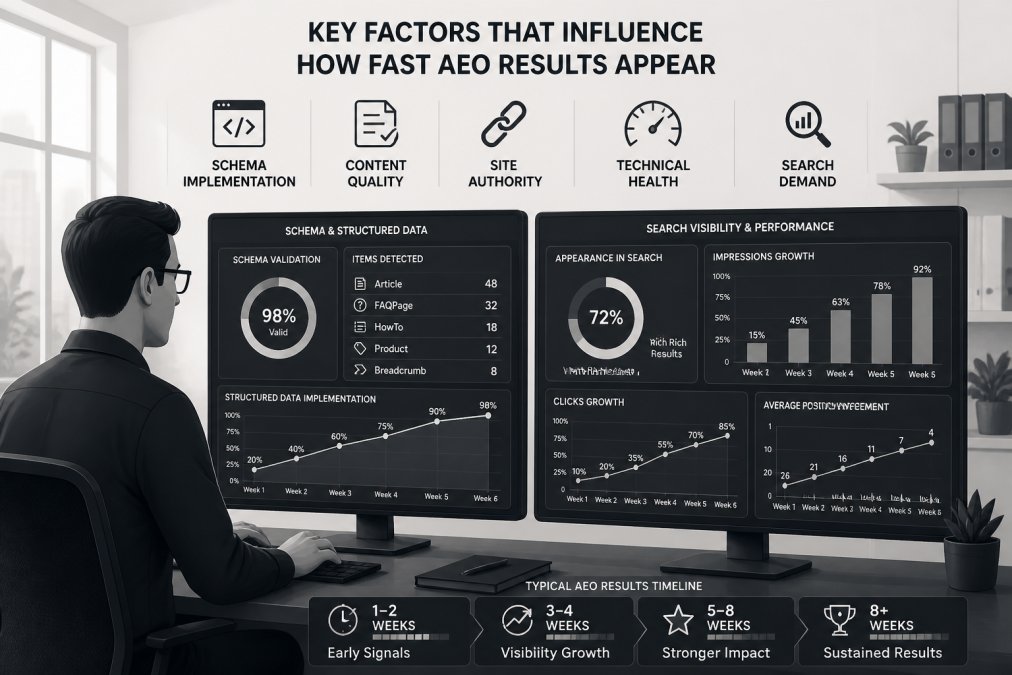
Established domains with strong backlink profiles see AEO results faster than new domains. This reflects how AI systems assess trustworthiness. Content freshness matters equally: AI systems prioritise recently updated content, especially for topics where information changes frequently. The combination is powerful, an established domain publishing fresh, authoritative content sees results within weeks.
Proper schema markup is arguably the single fastest lever for AEO visibility. When you implement FAQ schema, product schema, or article schema correctly, AI systems can parse your content immediately. Without schema markup, AI systems must use natural language processing, which takes longer and introduces ambiguity. The difference in timeline can be 2-4 weeks.
AI systems prioritise content that matches search intent precisely. A guide titled "How to implement AEO strategies" with clear steps and specific tool names will see faster results than vague advice. Entity recognition also matters: AI systems weight sources that mention named entities appropriately, helping them connect your content to relevant queries.
Write as if answering a person in conversation. AI systems trained on conversational data prioritise natural language patterns. Conversational optimisation means using contractions, asking questions, and structuring ideas as you'd explain them verbally. When you address the "why" behind your advice, you provide the context AI systems need to understand your content's value.
Citation frequency, how often your content is referenced internally and externally, signals authority to AI systems. Build citation frequency intentionally by linking from older posts to newer ones, creating cornerstone content that multiple articles reference, and encouraging external links through original research.
This is where YorkSoft Ltd's approach to rank monitoring and backlink analysis becomes relevant. Understanding your citation profile helps you build authority strategically rather than guessing which content needs more internal linking.
FAQ schema is one of the fastest ways to see AEO results. Format your answers to be self-contained so a person reading only the answer understands it completely. Direct answer formatting means leading with the answer, not building up to it. This structure aligns with how conversational search engines present information.
You can't improve what you don't measure. AEO success requires different metrics than traditional SEO.
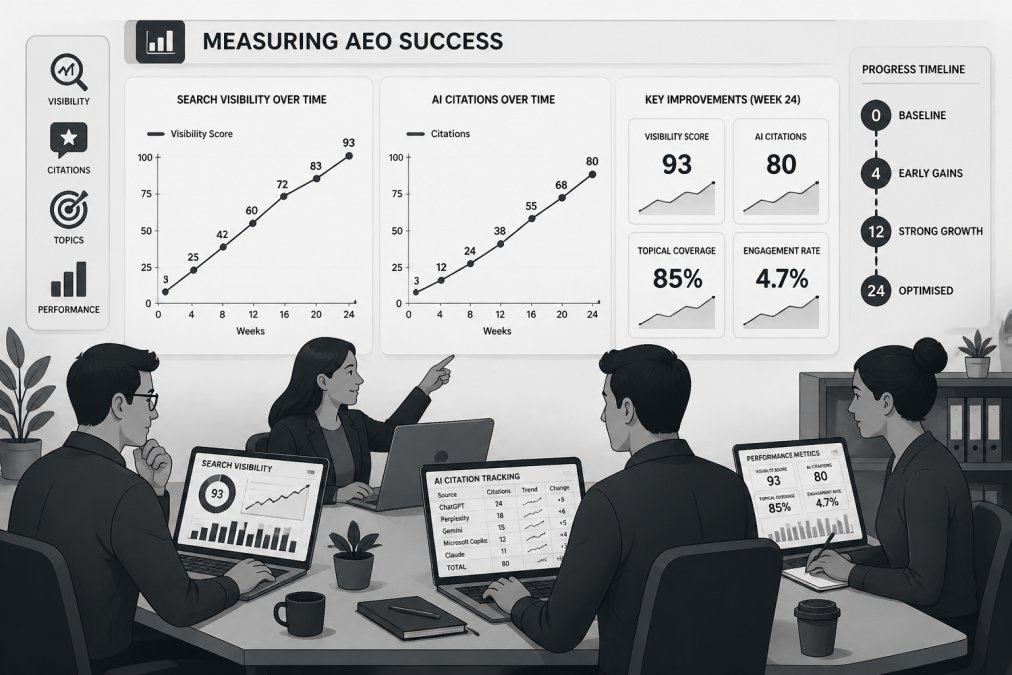
Track which queries trigger your content in AI responses. Use tools that monitor conversational search engines and AI answer engines. Note when your content appears, which queries trigger citations, and how often you're cited versus alternatives. Search visibility in this context means: "When someone asks a question that my content answers, does an AI system cite me?"
LLM-specific ranking factors include content freshness, citation frequency, schema markup implementation, and entity recognition. Real-time indexing matters more for AEO than traditional SEO. Monitor your indexing speed and confirm new content appears in search engines' indices within hours. Track schema markup validation using Google's rich results testing tool to confirm your structured data is correct.
Traditional SEO optimises for ranking in search results pages, a competitive and slow process. AEO optimises for being cited by AI systems, which is less competitive in early stages because fewer businesses are doing it. You can be cited without ranking first, meaning your AEO timeline might be faster than your SEO timeline, especially early on.
As the space matures, expect convergence. The businesses that rank well in traditional search will eventually dominate AEO visibility too, because underlying authority signals overlap.
Start by identifying your core topics and the questions your customers ask. Create cornerstone content that answers primary questions comprehensively, with proper schema markup.
Next, implement technical AEO. Audit your site for schema markup gaps and add FAQ schema to your most important pages. Validate all structured data. This phase typically takes 1-2 weeks and delivers quick wins.
Then establish a publishing rhythm. Consistency matters more than volume. Publishing one authoritative post per week with proper structure will outperform publishing five posts per month without structure.
If you're managing this internally, you'll need tools to track progress. YorkSoft Ltd provides rank monitoring and competitive AI analysis that help you measure AEO results alongside traditional SEO. For businesses without in-house expertise, working with an experienced team can accelerate results.
The timeline for AEO results depends on your starting position, content quality, and technical implementation. Quick wins appear within 1-4 weeks for low-competition queries. Moderate results emerge over 2-3 months as domain authority compounds. Sustained visibility for competitive queries typically requires 3-6 months of consistent effort.
The most common mistake is expecting immediate results and abandoning the strategy too early. AEO is a medium-term investment, not a quick fix. However, the payoff is significant: appearing in AI-generated responses means your content reaches users at the moment they're seeking answers. Starting now positions your business ahead of competitors still optimising for traditional SEO alone.
If you're ready to implement AEO properly, contact YorkSoft Ltd to discuss your content strategy and technical requirements. Our team specialises in rank monitoring, competitive AI analysis, and technical implementation that accelerates your AEO timeline. We'll audit your current position and build a roadmap to get you visible in AI responses faster.
| Timeline | Expected Results | Key Metrics | Effort Level |
|---|---|---|---|
| 1-4 weeks | Quick wins on niche queries | AI citations for long-tail terms, schema validation | Low to moderate |
| 2-3 months | Moderate visibility on semi-competitive queries | Consistent AI citations, search visibility growth | Moderate |
| 3-6 months | Sustained visibility on primary keywords | Regular citations, established authority, LLM rankings | Moderate to high |
| 6+ months | Dominant visibility, compounding authority | High citation frequency, primary keyword dominance | Ongoing maintenance |
SEO optimises for traditional search engine results pages, where domain authority and backlinks remain central. AEO (Answer Engine Optimization) targets AI-powered search and LLMs, which prioritise direct answers, structured data, and natural language processing. SEO typically takes 3-6 months for meaningful results; AEO can show early signals within weeks if your schema markup and FAQ formatting are strong. Both matter, but AEO requires specific technical SEO adjustments that traditional SEO alone doesn't address.
Monitor your content's appearance in AI-powered search results and LLM outputs using rank monitoring tools that track both traditional SERP position and answer engine visibility. Check whether your pages appear as direct answers, featured snippets, or cited sources in conversational search results. Real-time indexing monitoring shows how quickly your structured data and FAQ schema are being picked up. YorkSoft's rank monitoring and competitive AI analysis services help you track these metrics systematically, ensuring you see which optimisations are actually moving the needle.
Yes. Effective AEO requires proper schema markup (FAQ schema, Article schema, Entity schema), structured data implementation, and technical SEO foundations. Your content must be crawlable, your site must load quickly, and your information architecture must support entity recognition. Voice search and conversational search optimisation also benefit from clear, concise direct answers. If your current website lacks these elements, expect 2-4 weeks for technical implementation before you see AEO results. Custom web applications and bespoke solutions, like those YorkSoft develops, can be built with AEO requirements in mind from the start, avoiding costly retrofitting later.
Content authority, citation frequency, structured data completeness, and natural language alignment are critical. LLMs prioritise sources with high domain authority, fresh content, and clear entity recognition. FAQ schema and direct answer formatting increase the likelihood of being cited. Real-time indexing means content freshness matters more than in traditional SEO. Search intent alignment, matching how users phrase conversational queries, also accelerates visibility. An AEO strategy that combines these factors typically shows measurable results within 6-12 weeks, though quick wins in direct answer positioning can appear within 2-3 weeks.