
Aug 11, 2026 by Anthony York (YorkSoft Ltd)
Last Updated: August 11, 2026
Your website template worked beautifully when you launched. It was affordable, quick to deploy, and gave you a professional online presence without needing a developer. But as your business grows, that same template begins to feel restrictive.
What happens if you outgrow a website template becomes increasingly obvious when you hit specific friction points: your conversion rate stalls despite more traffic, feature requests pile up but the template doesn't support them, you want to integrate your retail management system directly into your site but the template's API capabilities are too limited, your pages load slower as you add more content, and the design that once felt modern now looks generic compared to competitors.

A common mistake is ignoring these warning signs because the template still technically works. But "works" isn't the same as "performs." When your website becomes a bottleneck to growth rather than an accelerant, that's the moment to seriously evaluate whether a custom solution would serve your business better.
The real cost of staying with a template you've outgrown isn't just missed revenue. It's the compounding technical debt that builds as you add plugins, workarounds, and custom code to bridge the gaps. Each patch makes the next change harder. Your hosting costs rise to compensate for bloated code. Your development team spends more time fighting the platform than building features.
Template platforms prioritise ease of use over performance optimisation. Most templates bundle bloated CSS and JavaScript that you'll never use, loading features for every possible use case even when you only need a fraction of them. Your pages carry excess weight that slows load times, and search engines penalise slow sites.
Schema markup, structured data, and advanced SEO configurations are either unavailable or severely limited in template systems. You can't implement custom JSON-LD schemas for your specific business type or optimise your site architecture for semantic relevance. You're stuck with whatever schema the template provides, which is usually generic and insufficient.
According to Google's Core Web Vitals guidance, page speed is a confirmed ranking factor. Template bloat directly undermines this. Custom development lets you build exactly what you need, nothing more. Every line of code serves a purpose. Your pages load faster and your SEO metrics improve.
Redirects and URL structure are another pain point. When you migrate platforms, managing 301 redirects becomes complex. With a custom solution, you control your URL architecture from day one, built for SEO rather than around template constraints. You avoid the redirect overhead that damages your link equity during migration.
Templates scale horizontally, more storage, more bandwidth, more features added to the existing platform. What they don't do is scale vertically; they don't transform as your business model evolves.
When you start with a template, you accept its fundamental architecture. If the platform wasn't designed for your specific use case, you're building on a foundation that will fight you as you grow. An e-commerce template might not handle complex inventory integration. A membership platform might not support the event coordination features your association needs.
The moment you need functionality the template doesn't offer, you face a choice: use workarounds that create technical debt, or migrate to a custom solution. Most businesses try workarounds first, adding plugins and custom code snippets that patch the gaps. This works temporarily but becomes increasingly fragile. Each workaround adds complexity, making your site harder to maintain, more vulnerable to security issues, and more prone to performance degradation.
Custom development scales with your business because you control the architecture. As your needs evolve, you modify the codebase directly. You don't negotiate with a platform's constraints or wait for feature releases. YorkSoft Ltd specialises in building bespoke web applications that grow with your business, designing systems around how your business actually works rather than forcing your operations into a template's framework.
The core difference between bespoke website development and templates comes down to control and customisation. A custom solution is built specifically for your business. Every feature serves a purpose. Every line of code is yours to modify.
Templates give you speed to market and lower upfront costs, but that generality is also the limitation. You're constrained by what the platform offers. You can't implement custom workflows, integrate systems the way you want, or optimise the user experience for your specific customers.
Bespoke development removes those constraints. You get a website built to your specifications with complete control over the codebase. You can integrate any third-party system and implement custom business logic that templates simply can't support.
Performance is measurably better with custom development. You're not carrying template bloat, so your site loads faster, your conversion rates improve, and your SEO performance improves. Security is stronger too, custom code is unique to your business, making it a less attractive target for attackers than widely-used templates.
Maintenance and support are also different. With custom development, you control when and how updates happen. You're not forced to upgrade to versions that break your customisations, and you can maintain stability while keeping your code current.
Custom development costs more upfront than a template, but the comparison is more nuanced than initial price tag. As you grow, template costs increase through premium plugins, hosting upgrades, and staff time managing limitations.
A custom solution requires significant upfront investment in design, development, testing, and deployment. But you're building an asset that's yours to keep. You're not renting a platform or subject to price increases and feature changes you don't want.
The long-term financial picture depends on your growth trajectory. For a business that grows, custom development becomes the cheaper option within a few years because you're not constantly fighting platform limitations. There's also the question of business continuity. With a template, you're dependent on the platform's viability. With custom development, you own the code and control your destiny.
YorkSoft Ltd can discuss your specific requirements and provide a detailed quote that reflects your actual needs. The investment should be evaluated against the revenue impact of better performance, faster feature delivery, and reduced operational overhead.
Moving from a template to a custom solution requires careful planning. A poorly executed migration can damage your SEO, lose customer trust, and create operational disruption.
Pre-Migration Planning
Technical Preparation
Content Migration
Launch and Monitoring
Post-Migration
A website redesign checklist ensures you don't miss critical steps. The difference between a smooth migration and a chaotic one often comes down to whether you've thought through these details in advance.
Moving from template to custom is a significant undertaking requiring clear thinking about your timeline, budget, and business priorities.
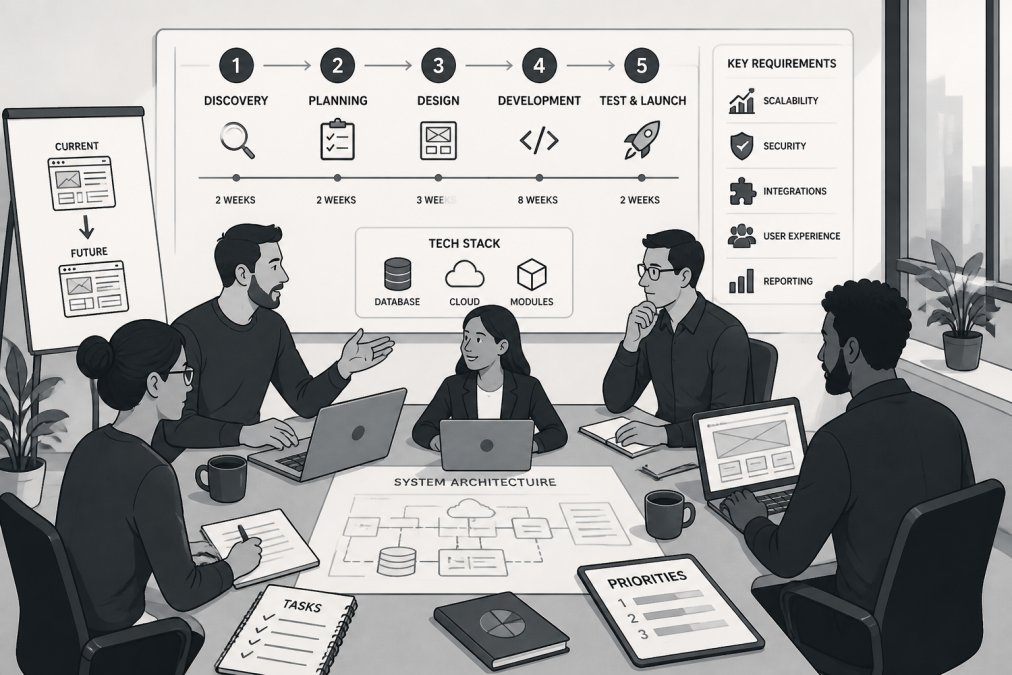
Start by defining what success looks like. Is it better performance? Specific features? Improved SEO rankings? Integration with your retail management system? The clearer your goals, the better your development partner can scope the work and estimate timelines.
Choose a development partner who understands your industry and your specific challenges. You need a partner who asks detailed questions about how your business operates, what your customers need, and what your competitive advantages are. YorkSoft Ltd specialises in custom solutions for specific business types, e-commerce operations needing retail system integration, associations requiring member management platforms, service firms pursuing technical SEO. This specialisation means they understand the constraints and opportunities in your industry.
Plan your timeline realistically. A simple custom website might take 8-12 weeks. A complex application with database functionality and integrations might take 4-6 months or longer. Budget for testing and refinement, as the development phase is only part of the project. You need time to test functionality, verify integrations, optimise performance, and train your team on the new system.
Consider a phased approach if your needs are complex. Launch core functionality first, then add advanced features in subsequent phases. This reduces risk, gets you live faster, and lets you validate assumptions before investing in less critical features.
Communicate regularly with your development partner throughout the project. Weekly check-ins catch problems early. Clear expectations about deliverables, timelines, and success criteria prevent misunderstandings.
What happens if you outgrow a website template is increasingly common as businesses scale. The template that launched your online presence becomes a constraint on your growth. Performance suffers, feature requests go unfulfilled, integrations become impossible, and technical debt accumulates.
Recognising these signs early gives you time to plan a thoughtful transition rather than reacting to a crisis. Custom development isn't the right choice for every business, but for businesses with specific integration needs, complex workflows, or serious SEO ambitions, it's often the only choice that actually solves the problem.
YorkSoft Ltd can help you evaluate whether custom development makes sense for your situation. We've built bespoke solutions for e-commerce businesses needing retail system integration, associations managing memberships and events, and service firms pursuing competitive SEO strategies. Contact YorkSoft Ltd to discuss your requirements and explore whether a custom solution would accelerate your growth.
Common indicators include slow page load speeds, inability to customise design beyond template constraints, difficulty integrating with your business tools, poor SEO performance as competitors rank higher, and inability to handle traffic spikes. You may also notice that your brand identity doesn't fully align with template limitations, or your conversion rates stagnate despite marketing efforts. If you're spending hours working around platform restrictions instead of growing your business, migration to a custom solution becomes essential.
Template platforms often limit technical SEO customisation, you cannot fully control schema markup, URL structures, or site architecture. Plugin bloat from third-party extensions slows page load speed, a critical ranking factor. Limited customisation of meta tags, heading hierarchy, and content management system flexibility means competitors with custom builds rank higher. As your business grows, these constraints compound, making it harder to implement advanced SEO strategies like API integration for structured data or custom redirect logic for platform migrations.
Template websites have lower upfront costs but hidden expenses accumulate: premium plugins, monthly hosting fees, and limited scalability mean you'll eventually rebuild. Custom development requires higher initial investment but provides long-term ROI through scalability, reduced maintenance overhead, and the ability to integrate directly with your business systems. Custom solutions eliminate plugin bloat and security vulnerabilities associated with third-party extensions. Pricing depends on your specific requirements, feature complexity, and integration needs, contact YorkSoft for a detailed quote tailored to your business goals.
Yes, content migration is possible but requires careful planning. You'll need to map your existing content structure to the new architecture, set up 301 redirects to preserve SEO value, and ensure no data is lost during transfer. Custom development allows you to restructure content for better user experience and SEO performance. Data migration strategies should include backup procedures, testing on a staging environment, and verification that all integrations work correctly before going live. This is where technical expertise becomes critical, poor migration planning can result in broken links, lost rankings, and downtime.