
Aug 07, 2026 by Anthony York (YorkSoft Ltd)
Last Updated: August 7, 2026
Custom API integration is the process of building tailored connections between software systems that wouldn't otherwise communicate. Rather than relying on pre-built connectors or off-the-shelf solutions, custom API integration involves writing code to establish direct data exchange between applications, databases, and platforms specific to your business needs.
The difference between custom and native integration matters more than most businesses realize. A native integration is a pre-built connection that a vendor has already created for you, think Shopify's built-in connection to PayPal. Custom API integration, by contrast, is purpose-built for your exact workflow. You're defining the rules, the data flow, the timing, and the logic that moves information between systems.
At YorkSoft Ltd, we've seen countless businesses trapped in a cycle of manual data entry because their systems don't speak to each other. A retail management system won't talk to a website platform. An accounting package won't sync with a CRM. Email lists sit in spreadsheets instead of flowing automatically into your marketing tool. Custom API integration solves this by creating the middleware that bridges these gaps.
The technical foundation involves RESTful APIs, JSON payloads, authentication protocols like OAuth, and webhooks that trigger actions in real time. But the business value is simpler: your data flows where it needs to go, automatically, without human intervention.
Custom API integration directly addresses operational efficiency. When systems are disconnected, your teams waste hours copying data between platforms, re-entering information, and chasing down inconsistencies. A custom integration eliminates that waste.
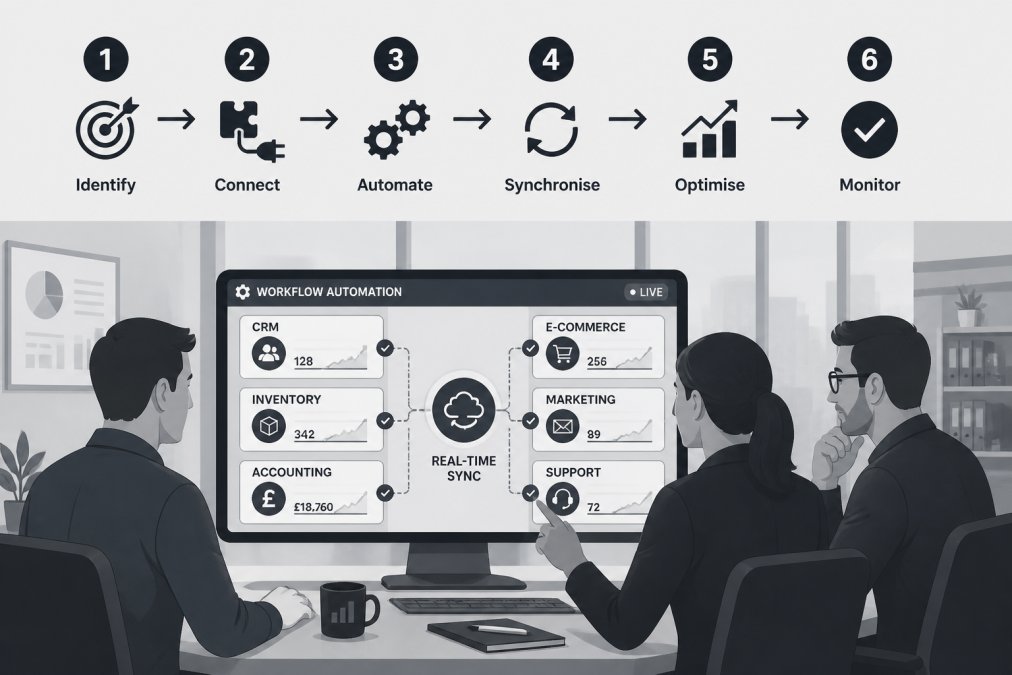
Consider a typical e-commerce scenario. Your website records a sale. That order needs to reach your retail management system, which needs to update your accounting software, which needs to feed into your analytics platform. Without integration, someone manually enters the order into each system. With custom API integration, the data moves automatically across your entire software ecosystem.
Data integrity improves dramatically. Manual processes introduce errors. A customer name gets misspelled in one system, correct in another. Inventory counts diverge. Pricing becomes inconsistent. Custom API integration enforces data accuracy at the point of exchange, validating information before it moves between systems.
Scalability becomes possible without proportional increases in headcount. A business handling 50 orders per day can manage manual processes. One handling 500 orders per day cannot. Custom API integration lets you grow without hiring additional staff to manage data movement.
Real-time data synchronization is another critical benefit. Your inventory updates instantly across all channels. Customer information stays current everywhere it's stored. Financial records reflect actual transactions within minutes, not days. This real-time capability transforms decision-making because you're working with current data, not yesterday's snapshots.
Security and compliance improve when data flows through controlled channels. Rather than sharing database passwords or exporting sensitive information to spreadsheets, custom API integration uses authentication protocols that log every transaction, encrypt data in transit, and maintain audit trails. This matters particularly for businesses handling payment information, personal data, or regulated information.
Successful custom API integration starts with clear data mapping. Before writing a single line of code, define exactly which fields from System A correspond to which fields in System B. A customer's "contact name" in one system might be stored as "full_name" in another. Documenting these relationships prevents errors downstream.
Rate limiting and error handling prevent cascading failures. If System B goes offline, your integration shouldn't attempt unlimited reconnection attempts that clog your network. Build in exponential backoff, retry quickly at first, then with increasing delays. Log failures so your team knows when something broke.
Testing your integration thoroughly before going live is non-negotiable. Integration testing involves confirming that data moves correctly, transformations happen as expected, and edge cases don't cause silent failures. Test with realistic data volumes. A connection that works fine with 10 records per day might struggle with 1,000.
Documentation matters more than most teams think. When you leave a position or bring on new staff, the next person needs to understand how the integration works, where the code lives, what happens when it fails, and how to troubleshoot issues. This documentation becomes critical during maintenance.
Version control and change management prevent broken integrations. When you update an API endpoint or change data structures, you need a process for rolling out changes without disrupting live systems. This might involve staging environments, gradual rollouts, or feature flags that let you test changes safely.
Monitor your integrations continuously. Set up alerts that notify your team when data stops flowing, when error rates spike, or when latency increases. Many integration failures go unnoticed for hours or days until someone discovers data isn't syncing.
Native integrations are faster to implement. Shopify has already built the connection to Stripe. You enable it, configure a few settings, and you're done. This speed matters when you need a solution quickly and your use case matches what the vendor anticipated.
Native integrations cost less upfront. There's no development time, no specialist fees, no testing period. You're using pre-built functionality that the vendor maintains for you.
However, native integrations only work within the vendor's ecosystem. Shopify can't create a native connection to your bespoke accounting system built in-house. If your workflow doesn't match the integration's design, you're stuck adapting your process to fit the tool rather than having the tool fit your process.
Custom API integration requires more time and specialist knowledge. You need developers who understand your systems, your data structures, and the APIs you're connecting. This investment is substantial.
But custom integration solves problems that native solutions can't touch. You can integrate legacy systems that have no pre-built connectors. You can build logic that's specific to your business, rules about how data transforms, when it moves, what happens on error. You can connect systems from different vendors that have no relationship to each other.
The decision comes down to this: if your workflow fits within existing native integrations, use them. They're simpler and cheaper. If your needs are unique, or if you're connecting systems that don't have native connectors, custom API integration is your only option. YorkSoft Ltd helps businesses make this decision by analysing their specific systems and workflows, then recommending the approach that delivers the best return on investment.
Latency, the delay between when data is sent and when it arrives, is a common problem. If your integration processes thousands of records, moving them one at a time creates unacceptable delays. Batch processing handles this: group records together and send them in bulk, reducing overhead and improving throughput.
API rate limiting prevents you from overwhelming the receiving system. Many APIs allow only a certain number of requests per minute. If you exceed that limit, your requests get rejected. Design your integration to respect these limits. Queue requests and space them out rather than sending them all at once.
Authentication failures happen when credentials expire or permissions change. Use token refresh mechanisms that automatically renew authentication before it lapses. Monitor for authentication errors and alert your team immediately, this often signals a security issue that needs investigation.
Data validation prevents garbage data from corrupting your systems. Before data moves between systems, validate that required fields exist, that formats are correct, and that values fall within acceptable ranges. Reject invalid data and log it so your team can investigate why it failed.
Maintenance and technical debt accumulate over time. An integration built quickly to solve an immediate problem becomes harder to modify as requirements change. Budget time for refactoring, updating dependencies, and improving code quality. Neglecting this eventually makes the integration fragile and expensive to maintain.
Security vulnerabilities in integrations are often overlooked. Ensure API credentials are stored securely, never in source code or logs. Use HTTPS for all data transmission. Implement rate limiting to prevent abuse. Audit access logs to detect suspicious activity. Security breaches in integrations can expose sensitive business data, so treat them seriously.
Several categories of tools help manage custom API integrations. API management platforms provide dashboards for monitoring performance, enforcing rate limits, and managing credentials. They sit between your applications and your APIs, adding a control layer.
Integration platforms as a service (iPaaS) offer pre-built connectors alongside custom development capabilities. They're useful if you're combining native integrations with some custom work.
Monitoring and observability tools track what's happening inside your integrations. They log requests, responses, errors, and performance metrics. When something breaks, these tools help you diagnose the problem quickly.
For most UK businesses building custom integrations, the tools matter less than the approach. Whether you use open-source libraries or commercial platforms, the principles remain the same: clear data mapping, thorough testing, continuous monitoring, and proper documentation.
YorkSoft Ltd recommends selecting tools based on your team's expertise and your specific technical requirements rather than following trends. A tool that's popular doesn't help if your developers can't use it effectively.
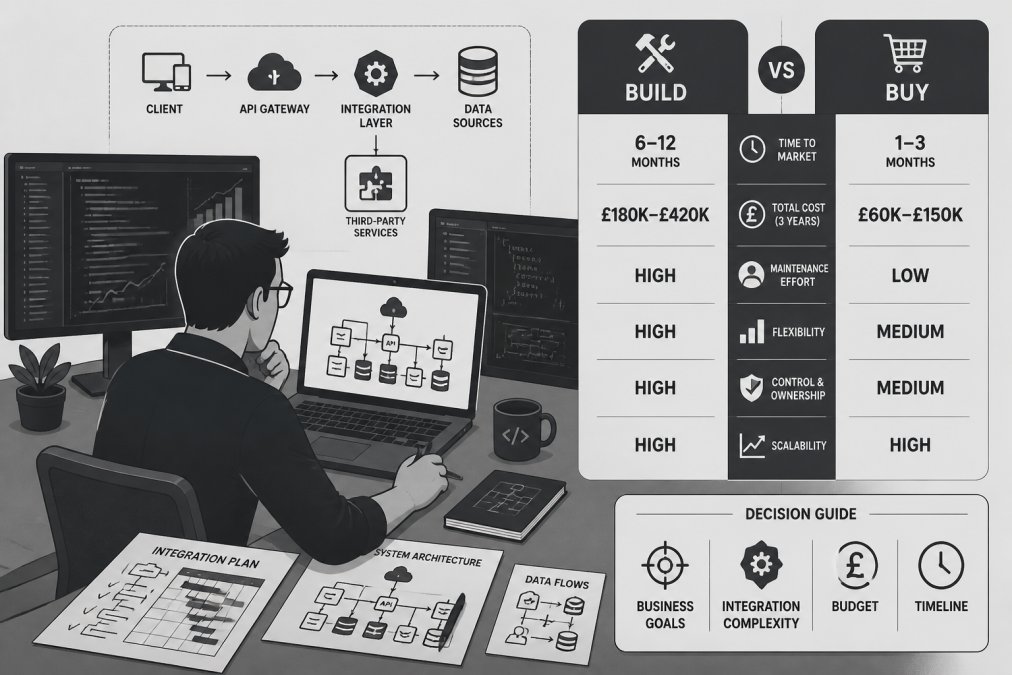
The build versus buy decision for custom API integration depends on several factors. Building custom integrations in-house gives you complete control and the ability to tailor solutions precisely to your needs. You own the code, understand it thoroughly, and can modify it without vendor dependencies.
Building requires maintaining a team with API development expertise. You're responsible for security updates, performance optimization, and ongoing support. If your specialist leaves, knowledge walks out the door with them. Technical debt accumulates if you don't invest in regular maintenance.
Buying from a development agency means outsourcing the expertise and initial development. You pay for specialist knowledge rather than building it in-house. The agency handles the initial build, testing, and deployment.
However, you're dependent on that agency for ongoing support and modifications. If the relationship ends poorly, you may struggle to find another developer who understands the custom code. Costs can escalate if the project scope expands beyond the initial estimate.
A hybrid approach often works best. Many businesses build simple integrations in-house using standard tools and libraries, then outsource complex custom work to specialists. This balances cost, control, and expertise.
For businesses in the UK without strong in-house development capacity, working with a specialist like YorkSoft Ltd makes sense. We handle the technical complexity, manage the integration lifecycle, and ensure your systems communicate reliably. This lets you focus on your core business rather than managing technical infrastructure.
The build versus buy decision should factor in total cost of ownership over multiple years, not just the initial development cost. A cheap initial build that requires constant maintenance becomes expensive quickly. A well-built custom integration from a capable agency pays for itself through improved efficiency and reduced manual work.
Custom API integration transforms how your business systems work together. Instead of manual data entry, spreadsheet management, and disconnected processes, your applications communicate automatically, keeping data accurate and current across your entire software ecosystem.
The decision to implement custom API integration should be driven by your specific business needs. If native integrations solve your problem, use them. If your workflow requires custom connections between systems, custom API integration is worth the investment.
Choosing the right partner for custom API integration matters as much as the technology itself. YorkSoft Ltd specialises in building bespoke integrations that connect your systems seamlessly, improve operational efficiency, and reduce manual work. With expertise in system architecture, data mapping, and API development, we ensure your integration is built to last and performs reliably. Contact YorkSoft Ltd today to discuss how custom API integration can transform your business operations.
A custom API integration is a bespoke connection built specifically for your business systems. Unlike off-the-shelf solutions, it links your software applications, databases, and platforms to exchange data automatically. This means your retail management system talks directly to your website, your accounting software syncs with your e-commerce platform, and manual data entry disappears. Custom API integration is designed around your exact workflow, not a generic one.
Custom API integration eliminates manual data transfer between systems. Instead of entering the same information into multiple platforms, data flows automatically in real-time. A team managing membership records, event bookings, and payments can automate the entire process. Real-time data synchronisation means no delays, fewer errors, and staff time redirected to strategic work rather than repetitive tasks. Most businesses report significant time savings within weeks of implementation.
Common challenges include managing technical debt as systems evolve, ensuring data integrity across platforms, handling authentication securely, and maintaining the integration as your business grows. Legacy systems may lack proper API documentation, creating compatibility issues. Security vulnerabilities can emerge if authentication protocols aren't implemented correctly. Testing becomes complex when multiple systems interact. Working with experienced developers who understand these challenges, like YorkSoft, helps you avoid costly mistakes and build integrations that scale with your business.
Native integrations work well if your software providers offer pre-built connectors that match your exact needs. However, they often lack flexibility and may not support your specific business logic. Custom API integration gives you complete control, better scalability, and solutions tailored to your workflows. For SMEs with unique processes, particularly in membership management, automotive retail, or niche services, custom integration typically delivers better long-term value. The decision depends on your system complexity and growth plans.