Aug 25, 2026 by Anthony York (YorkSoft Ltd)
Last Updated: August 25, 2026
Google reviews are no longer optional for repair shops. They're the deciding factor in whether potential customers walk through your door or call a competitor instead. According to BrightLocal's 2026 consumer research cited by the UK CMA, 90% of consumers rely on online reviews when making purchase decisions. For mechanics specifically, the stakes are even higher: customers are trusting you with their vehicles and their safety.
The numbers tell a compelling story. A single positive review can increase conversions by 10%, while accumulating 100 reviews can lead to a 37% increase in conversion rates. Businesses with more than 50 reviews generate 4.6% higher conversion rates. That's not incremental improvement, that's transformational growth from a free channel.
Here's what most repair shops miss: it's not about having perfect reviews. According to SF Digital Studios' 2026 analysis, the highest-converting Google Business Profiles sit at 4.5 to 4.7 stars with 5-15% critical reviews and visible professional responses. Only 20.5% of consumers trust a brand that shows nothing but five-star praise. Customers are increasingly sceptical of flawless ratings, they want proof that real people have real experiences, both positive and negative.
For independent garages in Northampton and across the UK, how to get more google reviews for mechanics 2026 is a strategic priority. But generating reviews requires a systematic approach, not sporadic requests. This guide covers the exact methods that work, from request templates to automation strategies, plus the legal boundaries you need to understand.
The biggest mistake repair shops make is asking for reviews at the wrong moment or in the wrong way. Timing matters more than you'd expect. The ideal moment is immediately after the customer has experienced the value, typically when they pick up their vehicle and see that it runs smoothly again. That's when emotion is highest and satisfaction is fresh.
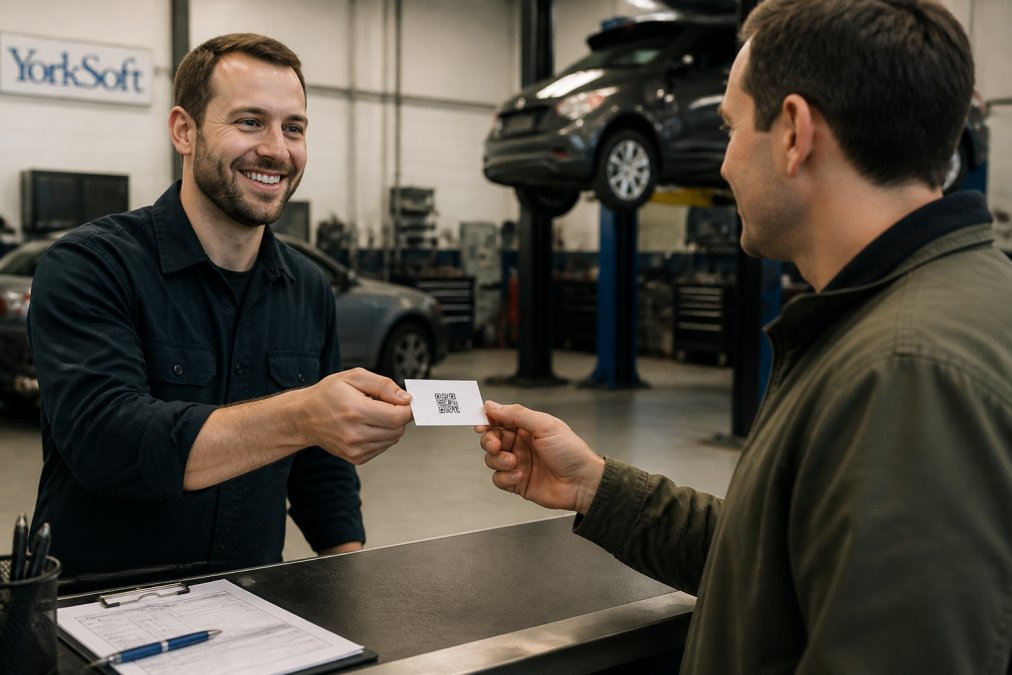
Here's a template that works for in-person requests at the point of service:
"We'd really appreciate your feedback on Google. It takes about 30 seconds and helps other car owners in Northampton find us. Here's a card with a direct link, just scan the QR code or click the link on your phone."
This works because it's brief, specific about the time commitment, and localises the benefit. Customers understand why their review matters to other local drivers.
For email follow-ups, use this structure:
Subject: We'd love to hear about your recent service at [Your Garage Name]
Hi [Customer Name],
Thank you for bringing your [vehicle type] in for service last week. We hope everything is running smoothly.
If you were happy with your experience, we'd be grateful if you could leave a quick review on Google. It helps local customers find us and tells us what we're doing right.
[Click here to leave a review] (link directly to your Google Business Profile)
Thanks again, [Your Name] [Garage Name]
The key difference from generic templates: mention the specific vehicle type and service. It shows you remember their job, not just their transaction. Research from Tempcover's 2026 survey of 2,000 UK drivers found that 83% of drivers trusted their last repair recommendation when transparency regarding repair costs and clear explanations of mechanical faults were provided. That same transparency builds trust for reviews.
SMS requests are increasingly effective for garages because most customers check their phones immediately. Keep it short:
"Thanks for choosing [Garage Name] for your service. If we did right by you, we'd love a Google review. Takes 30 seconds: [link]. Cheers!"
The psychology here is simple: make the ask easy, make the benefit clear, and make it feel personal, not like a mass campaign.
Your Google Business Profile is the foundation. If it's incomplete or poorly optimised, you're fighting uphill against every review request you send. Start with the basics: full business name, accurate address, correct phone number, and detailed business category (select "Auto Repair" specifically, not the vague "Automotive Service").
Hours matter more than you think. If your hours are wrong, customers will arrive to find you closed or leave frustrated messages. Update them immediately if you change seasonal hours or holiday closures. Google tracks consistency, profiles that match across all platforms rank higher.
Write a description that speaks to local customers in Northampton. Don't just list services; explain what you do differently. Example:
"Independent garage in Northampton specialising in diagnostic work and engine repairs. Family-run for 15 years. We explain every job in plain English so you understand what's wrong and why it matters. No surprise charges, we quote before we work."
This tells potential customers three things: who you are, what you do, and why they should trust you. That's more effective than "full-service auto repair."
Photos are underestimated. Add images of your garage interior, your team, and recent work (with customer permission). Avoid stock photos, they're immediately obvious and undermine trust. Real photos of your actual workspace, your mechanics at work, and happy customers build credibility. Update them quarterly.
Respond to every review, positive or negative. This is where most shops fail. A response to a five-star review takes 20 seconds but signals to potential customers that you're engaged. A thoughtful response to a negative review can actually increase trust, it shows you take feedback seriously.
Manual review requests work, but they don't scale. As your garage grows, you need systems that generate requests automatically without feeling robotic. The best approach combines email automation with SMS triggers based on service completion.
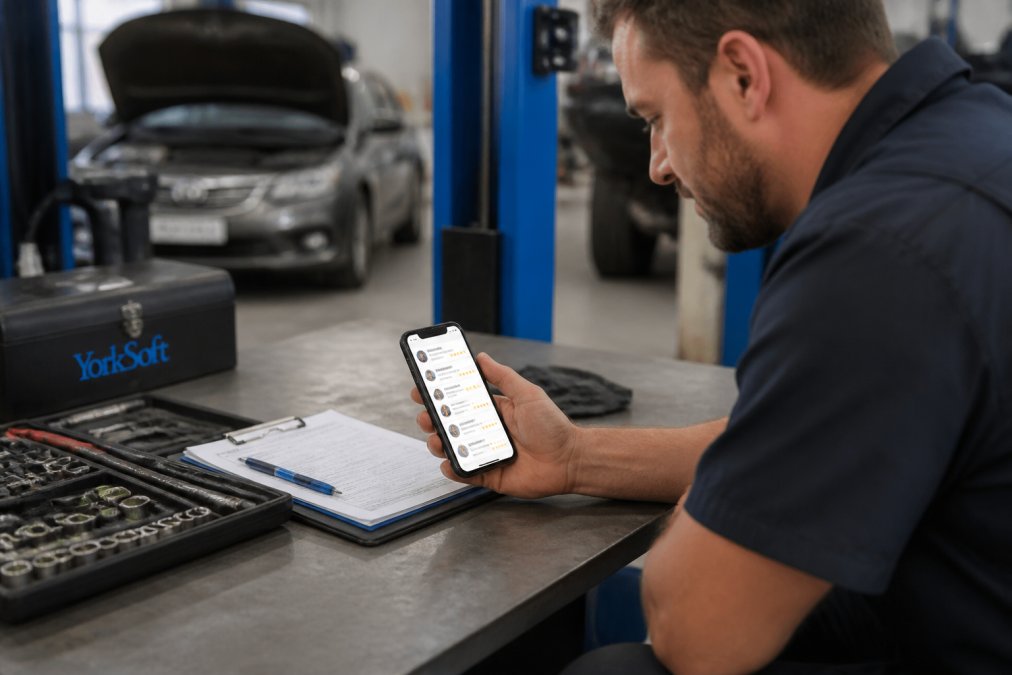
Set up an automated email sequence that triggers when a customer's job is marked complete in your system. Send the first email the same day, then a follow-up three days later if they haven't left a review. Most review management platforms integrate directly with Google Business Profile, making it simple for customers to leave feedback without hunting for your listing.
SMS automation is even more effective for time-sensitive requests. A message sent within two hours of service completion sees higher response rates. Automated systems can help achieve higher response rates on feedback requests.
The technology here isn't complex. Platforms exist that connect to your booking system, trigger requests automatically, and track which customers have already left reviews (so you don't spam repeat requesters). The value isn't in the tool itself, it's in consistency. Automated systems never forget to ask, never skip the busy day, and never let a satisfied customer slip away without a chance to leave feedback.
For garages in Northampton managing multiple service bays, automation becomes essential. You can't rely on individual mechanics remembering to hand out cards or send emails. A centralised system ensures every customer gets asked, every time. spotting fake reviews.
A negative review isn't a disaster, it's an opportunity to show how you handle problems. The worst response is no response. The second-worst response is defensive.
When a customer leaves a critical review, your first instinct might be to argue. Resist it. Instead, acknowledge the complaint specifically, apologise if appropriate, and offer to fix the problem. Example response:
"We're sorry your experience didn't meet your expectations. We take pride in clear communication about repair costs, and it sounds like we fell short there. We'd like to make this right, please call us directly at [number] so we can discuss what happened."
This tells potential customers three things: you read the reviews, you care about the feedback, and you're willing to resolve problems. That response often converts a detractor into a customer who comes back and updates their review.
Never respond emotionally or late at night. Wait 24 hours if you're frustrated. Your response is public, it's part of your marketing. Make it professional and solution-focused.
For reviews that contain factual errors (wrong service date, misunderstood repair), politely correct the record:
"We appreciate the feedback. Just to clarify: the service you received on 15 June was a full diagnostic and replacement of the timing belt, which we quoted at £450 on 14 June. If there's a discrepancy you'd like to discuss, please call us directly."
This protects your reputation without escalating conflict. Potential customers see that you stand behind your work but remain respectful.
The moment you ask for a review determines whether you get one. Research shows the highest conversion happens within 24 hours of service completion, when satisfaction is highest. After a week, response rates drop by half.
For routine services (oil changes, filters, inspections), ask immediately. For complex repairs, ask when the customer picks up the vehicle and it's running properly. For ongoing work, ask after each milestone is complete, not at the end of a multi-week job.
Frequency matters too. Don't ask the same customer for a review every visit. Once per year is reasonable; once per transaction for a regular customer feels like spam. Track who's already left reviews so you don't chase repeat requesters.
Personalisation increases response rates significantly. "We'd love your feedback" is generic. "We'd appreciate your review of the diagnostic work we did on your engine" is specific and shows you remember the job. Customers respond better when they feel individually addressed, not part of a mass campaign.
The channel matters. In-person requests at pickup convert best. Email converts second. SMS converts third but reaches people fastest. Use a combination: ask in person, follow up with email, then SMS if they don't respond within a few days.
The Competition and Markets Authority (CMA) has made it clear: fake and misleading reviews are illegal. As of April 2025, several practices became banned under the Digital Markets, Competition and Consumers Act 2024. You cannot pay customers for reviews, you cannot write reviews yourself and pretend they're from customers, and you cannot remove negative reviews without cause.
What you can do: ask for reviews, make it easy to leave them, and respond professionally to all feedback. That's ethical and legal.
You must disclose any incentives you offer. If you're running a promotion ("Leave a review, get 10% off your next service"), say so clearly. The incentive must be reasonable and not contingent on the review being positive. The CMA's guidance is explicit: customers must feel free to leave honest feedback, positive or negative.
Be transparent about your review generation process. If you're using automation or a third-party platform, that's fine, but customers should understand they're being asked by a system, not personally. Deceptive practices, like fake review requests that look like they're from individuals, violate the rules.
For garages in Northampton and across the UK, the safest approach is simple: ask genuinely satisfied customers for honest feedback, make the process easy, and respond professionally to whatever they say. That's both legal and effective.
Getting more Google reviews for mechanics in 2026 requires a shift from hoping customers will leave feedback to systematically asking them at the right moment, in the right way. The data is clear: reviews drive conversions, and a balanced profile with both praise and critical feedback builds more trust than perfection.
If you're managing multiple locations or complex service workflows, automation removes the guesswork. YorkSoft Ltd specialises in building custom systems that integrate with your existing garage management tools, automating review requests and tracking responses so you never miss a satisfied customer. YorkSoft's platform connects to your booking system, triggers requests at the optimal moment, and provides visibility into which customers have already left feedback. Contact YorkSoft Ltd to discuss how automation can accelerate your review growth without the manual overhead.
Timing is key. Request reviews immediately after completing the service when satisfaction is highest, ideally within 24 hours. Keep your ask brief and genuine: 'We'd appreciate your feedback on Google if you had a positive experience.' Provide a direct link to your Google Business Profile to reduce friction. Avoid repeated requests or aggressive follow-ups, which damage trust.
Yes. The Competition and Markets Authority (CMA) has strict rules under the Digital Markets, Competition and Consumers Act 2024 (DMCC Act), effective April 2025. You cannot offer payment, discounts, or rewards in exchange for reviews or specific ratings. You can ask customers to leave honest feedback, but any incentive must be unrelated to the review itself. The CMA has launched investigations into fake and misleading reviews, making compliance essential. Always ensure reviews are genuine and unmanipulated.
Request reviews within 24 hours of service completion, while the customer's experience is fresh and satisfaction is highest. If you offer a follow-up call to check satisfaction, that's the ideal moment to ask for a review. Avoid requesting during or immediately after payment, which can feel transactional. SMS or email requests sent the next morning typically see the highest response rates. For warranty or recall work, wait until the customer has had time to verify the repair solved their problem.
YorkSoft specialises in custom web applications and automation solutions tailored to automotive businesses. We can build integrated systems that automatically trigger review requests via SMS, email, or your website after service completion, reducing manual effort and increasing response rates. Our platform includes rank monitoring and Google Business Profile optimisation to help you track review impact on local rankings. Contact us to discuss how we can streamline your review generation process with bespoke automation.