Aug 13, 2026 by Anthony York (YorkSoft Ltd)
Last Updated: August 13, 2026
Local search is how customers find repair services. When someone's car needs attention, they search "car repairs near me" or "mechanics in [area]", not national directories. For independent automotive repair centres, ranking in local search results directly drives foot traffic and phone calls.
Local search algorithms prioritise Google Business Profile optimisation, review signals, citation consistency, and technical SEO. Most repair shops focus on one or two factors and wonder why they're not showing up on Google Maps. The real opportunity lies in treating local SEO as a complete system.
At YorkSoft Ltd, we empower businesses to enhance their online presence through expert SEO / AEO and GEO strategies, including rank monitoring, keyword analysis, and high-quality link building and AI analysis and monitoring. The difference between a shop that ranks and one that doesn't often comes down to execution consistency rather than budget or size.
This guide covers the seven steps that move the needle: from optimising your Google Business Profile through to monitoring progress. Each section addresses a specific ranking factor, and together they form a foundation that generates qualified local leads.
Your Google Business Profile is the single most important asset for local search ranking. It's the first thing potential customers see and a major ranking signal for Google Maps and local pack results.
Many repair shops treat their Business Profile as a one-time setup task. A fully optimised profile, with complete information, high-quality images, regular updates, and accurate service categories, sends strong signals to Google's algorithm.
Claim your profile at Google Business Profile if you haven't already. If your profile doesn't exist, create one.
Fill in every field completely. Include your full business name exactly as it appears on your signage and legal documents. Add your phone number, website URL, and physical address. This information, known as NAP (Name, Address, Phone), must match exactly across your website, directories, and all citations. Inconsistencies confuse Google's algorithm and weaken your local ranking.
Select the correct business categories. For automotive repair, choose primary categories like "Auto Repair Shop" or "Mechanic" and add secondary categories that reflect your specialisms: "Brake Service," "Oil Change Service," "Transmission Repair," or "Electrical Repair." These categories help Google match you to relevant search queries.
Add your business description in the "About" section. Write 2-3 sentences describing what you do, who you serve, and what makes your shop different. This text appears in search results and on your profile.
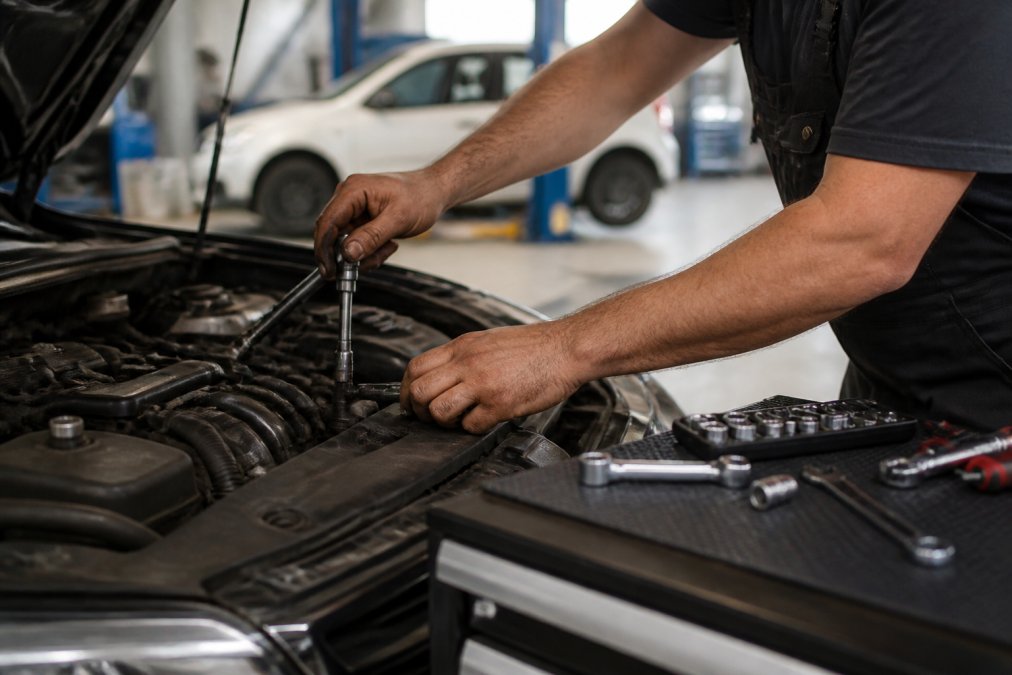
Photos are critical. Profiles with multiple high-quality images rank higher and receive more clicks. Google's algorithm treats photos as a ranking signal, and customers use them to assess your shop's professionalism.
Add at least 10-15 photos covering your shop exterior, workshop interior, team members at work, before-and-after repair shots, specific services, and customer waiting area. Use high-resolution photos taken in natural light where possible.
Update your photos regularly. Every few weeks, add a new image. Google rewards fresh content, and regular updates keep your profile visible in the "Updates" section, driving additional engagement.
Google Maps ranking depends on relevance, distance, and prominence. Relevance comes from your profile optimisation and keyword alignment. Distance is based on the searcher's location. Prominence is built through reviews, citations, backlinks, and local authority signals.
To rank higher, you need to optimise for all three. Most repair shops focus only on distance and ignore the factors they can control: relevance and prominence.
NAP consistency is one of the highest-impact local SEO factors. Google uses your Name, Address, and Phone number to verify your business identity and build local authority. Inconsistencies across the web confuse Google and weaken your local ranking.
Audit your NAP across every platform: your website, Google Business Profile, Apple Maps, industry directories (Yell.com, Yelp, Trustpilot), local business directories, and social media profiles.
Your address should be identical everywhere. If your street address is "123 High Street," don't list it as "123 High St" elsewhere. Phone numbers should include the same formatting. Your business name should match exactly.
Prioritise fixing inconsistencies in the highest-authority sources first: your website, Google Business Profile, and major directories. When you move locations or change your phone number, update every listing simultaneously.
A citation is any online mention of your business name, address, and phone number. Citations are local ranking signals that tell Google your business is real, established, and trusted.
Build citations by listing your business in relevant directories:
When adding your business to a new directory, ensure your NAP matches exactly what's on your website and Google Business Profile. This consistency creates the ranking signal.
After your core citations, look for local directories specific to your area or region. These carry less weight than national directories but still contribute to local ranking. Aim to add your business to 5-10 high-authority directories over the next few months.
Online reviews are a direct ranking factor for local search and influence customer decisions. Most people read reviews before choosing a repair shop. A shop with many 5-star reviews ranks higher and gets more customer calls than one with few or mixed reviews.
You need a system to encourage satisfied customers to leave reviews and to respond professionally to all feedback.
The most effective way to generate reviews is to ask for them right after a positive service experience, when the customer is most satisfied.
Implement a simple system: hand customers a card or print a receipt with a link to your Google Business Profile review page, include a QR code that takes them directly to your review form, follow up with an email 24 hours after service completion with a direct review link, and train your team to mention reviews when customers check out.
Make the process frictionless. A QR code that opens the review form in one tap is far more effective than asking customers to search manually.
Aim for consistency. If you generate 2-3 new reviews per week, you'll build a strong review base over time. Focus on quality over quantity, detailed, specific reviews are more valuable than generic ones.
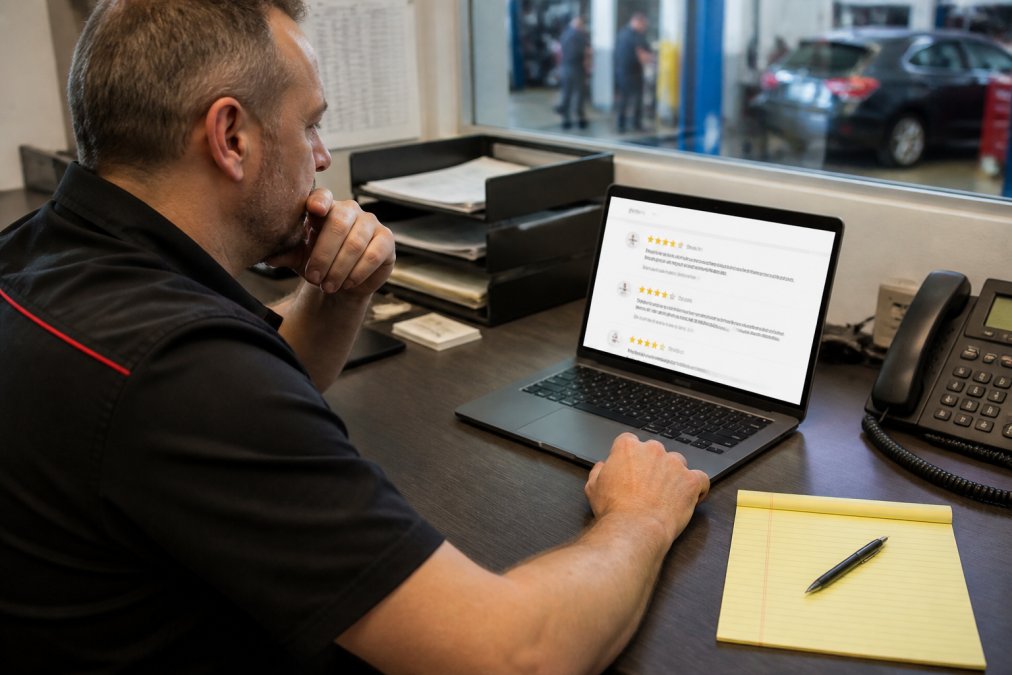
Every review, positive or negative, deserves a response. Responding signals to Google that your business is active and engaged, and gives you a chance to address concerns and show potential customers how you handle feedback.
For positive reviews, respond with a brief thank-you message mentioning the specific service if applicable:
"Thank you for leaving us a review. We're glad we could help with your brake service. We look forward to seeing you again."
For negative reviews, respond calmly and professionally. Never argue or dismiss the customer's concern. Instead, acknowledge their experience and offer to resolve it:
"We're sorry to hear you had a poor experience. We take customer feedback seriously. Please contact us directly at [phone number] so we can make this right."
Respond to all reviews within 48 hours. This speed signals that you're actively managing your reputation and care about customer feedback.
A local SEO audit identifies gaps in your current strategy. You can conduct a basic audit yourself using freely available tools.
Your website is the foundation of your local SEO. If it's slow, poorly structured, or not mobile-friendly, it won't rank well.
More than 60% of repair shop searches happen on mobile devices. If your website isn't responsive and loads quickly on phones, you're losing customers and ranking points.
Test your website's mobile performance using Google's PageSpeed Insights tool. This free tool identifies specific issues like large uncompressed images, render-blocking JavaScript, and poor mobile layout. Fix the highest-impact issues first.
Check your website structure. Your site should have a clear hierarchy: homepage → service pages → individual service details. Each service should have its own page with detailed information, local keywords, and customer testimonials.
Ensure your contact information is visible on every page. Your NAP should appear in the header, footer, and contact page.
Schema markup tells Google what your content means. For a repair shop, schema helps Google understand your services, location, reviews, and business information.
Implement these schema types: LocalBusiness schema (your business name, address, phone, hours, and services), Service schema (each service you offer), Review schema (customer reviews in search results), and FAQPage schema (your FAQ section).
Tools like Google's Structured Data Markup Helper make adding schema easier. If your website uses WordPress, plugins like Yoast SEO or Rank Math can add schema automatically.
Test your schema using Google's Rich Results Test to see how Google interprets your markup.
Hyper-local content targets specific geographic areas and services. Instead of one generic "Brake Repair" page, create pages for "Brake Repair in [Town]" or "Brake Repair for [Vehicle Type]."
This approach improves visibility because it matches how customers search. Someone searching "brake repair in Manchester" is more likely to find a page specifically about Manchester brake services.
Create service pages for each major service you offer. Include service name and description, why the service matters, your process or approach, customer testimonials, local keywords woven naturally into the content, and a clear call-to-action.
Add location pages if you serve multiple areas. A page for "Car Repairs in Manchester" should include information specific to that area and local keywords.
Use local keywords naturally throughout your content. Research keywords like "car repairs near me," "mechanics in [town]," and "[service type] repair [town]." Include these in page titles, headings, and body content where they make sense. Avoid forced keyword stuffing.
Local SEO requires ongoing monitoring and adjustment. Track these metrics monthly: local pack rankings for key local keywords, organic traffic to your website, phone calls and quote requests, review count and rating, and website performance.
Use Google Search Console to monitor your search performance. This free tool shows which keywords drive traffic, how often you appear in search results, and your average ranking position.
Set up conversion tracking on your website using Google Analytics to track phone calls, form submissions, and other customer interest indicators. This data shows which pages and keywords actually drive business.
Review your progress quarterly. Are you ranking higher for target keywords? Are you getting more phone calls and quote requests? If not, identify what's not working and adjust. Maybe your service pages need more detailed content, or your review generation process needs improvement.
Shops that succeed with local SEO treat it as an ongoing process, not a one-time project. Consistent effort, optimising your profile, generating reviews, building citations, and improving your website, compounds over time and builds local authority.
Improving local SEO for automotive repair requires attention to multiple ranking factors working together. Your Google Business Profile, review strategy, citation consistency, and website optimisation form the foundation. YorkSoft Ltd provides comprehensive digital solutions specializing in web development and custom web applications. We empower businesses to enhance their online presence through expert SEO / AEO and GEO strategies, including rank monitoring, keyword analysis, and high-quality link building and AI analysis and monitoring. YorkSoft is dedicated to delivering technical excellence and competitive insights to help your brand succeed in a crowded digital landscape. Contact us to discuss how we can help your repair shop rank higher and attract more qualified local customers.
Start with three immediate actions: claim and complete your Google Business Profile with accurate details, ensure your name, address, and phone number (NAP) are consistent across all online directories, and encourage existing customers to leave reviews. These foundations take 1–2 weeks to establish and yield visible results within 30 days. YorkSoft can audit your current presence and identify gaps in your local SEO strategy through our rank monitoring and keyword analysis tools.
Google Business Profile optimisation combined with NAP consistency and customer reviews form the foundation. However, conversion-focused elements matter equally: your website must load quickly on mobile, display service-specific schema markup, and have clear conversion paths (booking buttons, phone numbers, location maps). Technical excellence separates shops that rank from those that don't. YorkSoft specialises in ensuring these technical elements work together seamlessly.
Yes. Local search drives 46% of all Google searches, and automotive repair is highly location-dependent. A mechanic ranking on Google Maps in their service area attracts qualified customers ready to book. The investment is modest compared to traditional advertising: focus on your Google Business Profile, reviews, and local citations first. As you grow, technical SEO and conversion optimisation deliver measurable returns. Contact YorkSoft to discuss how a tailored local SEO strategy fits your budget.
Claim your Google Business Profile, verify your business address, and ensure it matches your website and directory listings exactly. Add service categories (MOT testing, brake repairs, diagnostics), upload photos of your shop and team, and post updates regularly. Encourage reviews from customers. Google Maps ranking also depends on relevance (how well your profile matches search terms), distance (proximity to the searcher), and prominence (review count and recency). YorkSoft's rank monitoring tools help you track your Map position and identify optimisation opportunities.