Jul 24, 2026 by Anthony York (YorkSoft Ltd)
Last Updated: July 24, 2026
Choosing between template and custom websites is one of the most consequential decisions a business makes when building its digital presence. The choice affects everything from your launch timeline to long-term costs, SEO performance, and ability to scale. YorkSoft Ltd has helped hundreds of businesses navigate this decision, and the answer is rarely as simple as "one is always better."
The reality: most guides treat this as a binary choice. It isn't. Understanding the real trade-offs, not the marketing claims, is what separates businesses that build websites that actually drive results from those that end up frustrated with their choice in 18 months.
Template websites are built on pre-designed frameworks where you select a layout, customise colours and text, and add your content. Custom websites are built from scratch, written in code, designed specifically for your business needs. This distinction shapes every downstream decision: cost, timeline, flexibility, SEO potential, and how your site evolves as your business grows.
A template website uses a pre-built structure created by platform developers. You're working within an existing system, Wix, Squarespace, Shopify, where the underlying architecture, hosting, security, and core functionality are already determined. Your role is to populate it with your brand elements and content.
Template platforms typically offer drag-and-drop builders. You select a design, adjust the layout, upload images, and write copy. The platform handles hosting, SSL certificates, backups, and security updates automatically. For most small businesses launching their first website, this eliminates significant friction.
Wix starts from £9 per month (billed annually), Squarespace from £12 per month (billed annually). Shopify begins at £5 per month for basic plans, scaling to £19 per month (billed annually) for more advanced features. These are all-inclusive: hosting, domain management, and basic support are built in.
A custom website is built by developers using code, typically HTML, CSS, JavaScript, and a backend language like PHP or Python. The design, functionality, and technical architecture are created specifically for your business. Nothing is predetermined.
Custom development typically involves hiring a freelancer or agency. A simple custom site might cost £800 to £2,000. A complex e-commerce application with database integration, membership systems, or custom integrations could range from £5,000 to £20,000 or more. Development timelines range from 4 to 12+ weeks depending on requirements.
You own the code. You control the hosting. You decide which integrations connect to your systems. The trade-off: you're responsible for ongoing maintenance, security updates, and hosting infrastructure.
| Feature | Template Websites | Custom Websites | Winner |
|---|---|---|---|
| Time to Launch | 1-4 weeks | 6-12 weeks | Template |
| Upfront Cost | £9-50/month | £800-20,000+ | Template |
| Design Flexibility | Limited to templates | Unlimited | Custom |
| SEO Control | Moderate (platform constraints) | Full control | Custom |
| Scalability | Limited (platform caps) | Unlimited | Custom |
| Code Ownership | No (platform owns it) | Yes (you own it) | Custom |
| Integration Capability | App marketplace only | Any system | Custom |
| Mobile Responsiveness | Built-in | Built-in (when done well) | Tie |
| Long-term Value | Platform dependent | Appreciating asset | Custom |
| Maintenance Burden | Minimal (platform handles) | Ongoing (your responsibility) | Template |
The comparison reveals a pattern: templates win on speed and simplicity; custom wins on control and long-term value.
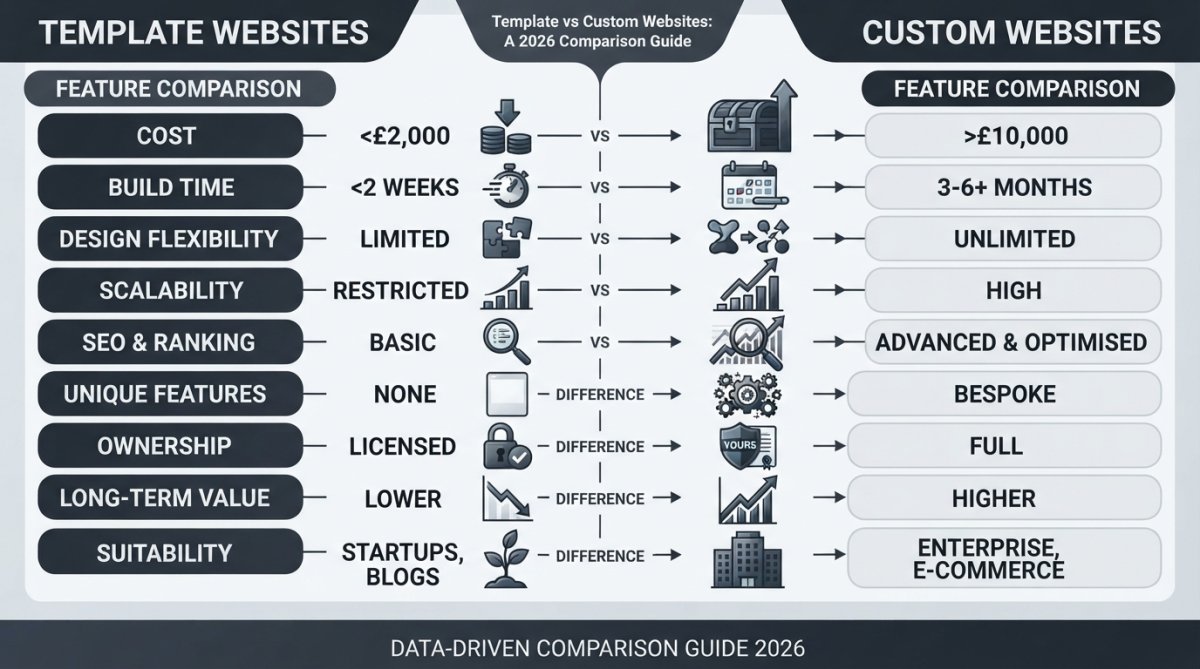
The case for templates is straightforward: they're fast, affordable, and require no technical expertise. You can launch a professional-looking website in days.
Advantages:
Templates remove technical barriers. You don't need to hire developers or learn to code. The platform handles hosting, security patches, SSL certificates, and backups automatically. Speed matters, a template site launches in 1-4 weeks. All-in-one pricing eliminates surprises, and mobile responsiveness is automatic on modern platforms.
Disadvantages:
Design constraints are real. You're choosing from a library of pre-made layouts, and two businesses using the same template will look similar. SEO flexibility is restricted, while template platforms offer basic SEO tools, you can't control the underlying code structure or advanced technical optimisations. Scalability hits a ceiling as your business grows and requires custom workflows or third-party integrations that templates can't accommodate.
You don't own your site. The platform owns the code. If you want to migrate later, you're starting from scratch. Long-term costs compound: at £20-50 per month, a template platform costs £240-600 annually. Over 5 years, that's £1,200-3,000 spent on a platform you don't own.
The case for custom websites is about control and long-term value. You're building an asset that belongs to you, optimised for your specific needs.
Advantages:
Unlimited design flexibility means your site reflects your brand precisely. Superior SEO performance is achievable, custom sites can be optimised at every level: code structure, page speed, Core Web Vitals, schema markup, and technical architecture. According to Google's Web Vitals documentation, sites with optimised Core Web Vitals see 24% fewer users leaving before the page loads.
Scalability is unlimited. As your business grows, add features and integrations without hitting platform limitations. Integration with business systems is seamless, connect your website directly to your CRM, inventory management system, accounting software, or membership platform. You own the asset: the code, design, and data are yours.
Disadvantages:
Higher upfront cost is the most obvious barrier. A simple custom site starts at £800-2,000; anything complex easily reaches £5,000-20,000+. Development timeline is longer, 6-12 weeks minimum. Ongoing maintenance is your responsibility: security updates, bug fixes, performance optimisations, and hosting management. Technical debt accumulates if your developer leaves or you switch teams. Custom development demands clearer requirements upfront and more involvement throughout the build process.
The cost comparison reveals why this decision feels difficult. Template websites have lower upfront costs but higher long-term costs. Custom websites have higher upfront costs but lower long-term costs.
Template websites: £9-50 per month, depending on platform and features. Total first-year cost: £200-1,000.
Custom websites: £800-20,000+ depending on complexity. A simple brochure site: £800-2,500. A small e-commerce site: £2,500-7,500. A complex application with integrations: £7,500-20,000+.
Template website 5-year cost:
Custom website 5-year cost:
On paper, the template wins on cost. But this ignores value. A custom site that generates 15% higher conversion rates through optimised design, faster page load times, and better user experience often generates enough additional revenue to cover the development cost within 12-18 months. Research from Forrester's e-commerce conversion analysis shows that optimised checkout flows and personalised user experiences increase conversion rates by 10-25%.
This is where template websites show their real limitation. SEO performance differs significantly between template and custom builds.
Custom websites allow optimisation at the code level. Your developer can implement schema markup for rich snippets, optimise Core Web Vitals (Largest Contentful Paint, First Input Delay, Cumulative Layout Shift), control page speed through image optimisation and caching strategies, structure URLs for semantic clarity, and implement proper heading hierarchy.
Template platforms provide basic SEO tools, meta descriptions, alt text, XML sitemaps, but you can't access the underlying code. If the platform's infrastructure is slow or poorly optimised, your site inherits those limitations. According to Google's Core Web Vitals guidance, pages that pass Core Web Vitals see 24% lower bounce rates than pages that fail.
Both template and custom websites can be mobile responsive. The difference is performance. Template platforms serve millions of sites from shared infrastructure, meaning shared server resources and shared performance constraints. Custom sites use dedicated hosting optimised for your specific needs, typically resulting in faster page load times.
For SEO rankings, page speed is a ranking factor. Faster sites rank better. Custom sites, when built properly, typically rank better than template sites on the same keywords.
Understanding the timeline and flexibility differences helps clarify why this decision matters.
Template websites: 1-4 weeks from signup to live site. Week 1: sign up and customise. Week 2: add pages and content. Week 3: configure integrations. Week 4: test and launch.
Custom websites: 6-12 weeks minimum. Weeks 1-2: discovery and requirements. Weeks 3-4: design mockups. Weeks 5-8: development. Weeks 9-10: testing and optimisation. Weeks 11-12: deployment and launch.
For businesses that need an online presence immediately, templates are the obvious choice. For businesses that can wait 2-3 months for a properly built site, custom is worth the wait.
Templates offer limited customisation. You're working within the template's structure. You can change colours, fonts, and layouts (within template options), but fundamental design changes, custom components, and specific user workflows aren't possible without hiring a developer.
Custom websites offer unlimited customisation. Any design you can imagine can be built. Custom components, unique interactions, and specific workflows are all possible. The constraint is budget and timeline, not technical capability.
Beyond the obvious benefits, custom development offers strategic advantages that matter for long-term business growth.
Your business will change. You'll add products, services, features, and integrations you can't predict today. A template site that works perfectly at launch often becomes a constraint as your business grows. You hit feature limits, integration needs exceed the platform's capabilities, and performance degrades.
A custom site scales with your business. Add features without rebuilding. Integrate with new systems without workarounds. For businesses planning to grow significantly in the next 3-5 years, custom development is an investment in flexibility.
As your business matures, your website needs to connect to other systems: CRM, inventory management, accounting software, email marketing platform, membership system. Template platforms handle common integrations through app marketplaces, but if your business uses custom or niche software, template platforms often can't integrate.
Custom websites integrate with any system through APIs. Your website becomes the central hub connecting all your business tools. For service businesses, e-commerce operations, or membership organisations, this integration capability is transformative.
The decision depends on three factors: timeline, budget, and long-term vision.
Choose a template if:
Choose custom if:
Consider hybrid if:
For most small businesses, the honest answer is: start with a template, launch quickly, validate your business model, then migrate to custom when you've proven the concept and have revenue to justify the investment. But for businesses that know they need custom features from day one, complex e-commerce, specific integrations, unique branding requirements, building custom from the start saves the cost and disruption of migrating later.
The choice between template and custom websites isn't really about which is "better." It's about which is better for your specific situation at this specific moment. YorkSoft Ltd specialises in custom web development for businesses that have outgrown templates or need capabilities templates can't provide. If you're considering a custom build and want to discuss whether it makes sense for your business, timeline, budget, and technical requirements, contact YorkSoft Ltd to explore options. We'll help you understand the real costs and benefits for your situation, and whether custom development is the right investment now or later.
Template websites use pre-designed layouts from platforms like Wix, Squarespace, or Shopify, allowing quick setup with drag-and-drop customisation. Custom websites are built from scratch by developers, offering complete control over design, functionality, and code. Templates suit businesses wanting rapid deployment; custom sites suit those needing unique functionality, superior SEO, or complex integrations with existing business systems.
Template websites typically start from around £9-£19 per month as subscription fees, making them budget-friendly initially. Custom website development costs vary significantly based on complexity, features, and your chosen developer. For precise pricing on custom solutions, contact YorkSoft Ltd to discuss your specific requirements and receive a tailored quote that reflects your project scope.
Custom websites generally offer superior SEO performance because developers can optimise code quality, page speed, Core Web Vitals, mobile responsiveness, and structured data from the ground up. Templates provide basic SEO tools, but they carry shared hosting infrastructure and less control over technical implementation. For businesses prioritising search engine rankings and organic visibility, custom development with expert SEO strategies, like those offered by YorkSoft Ltd, delivers stronger long-term results.
Custom website timelines depend on complexity, features, and integrations required. Simple sites may take 4-8 weeks; complex projects with database integration and custom functionality can take 3-6 months or longer. Templates launch in days to weeks. If you need a custom solution, YorkSoft Ltd can provide a realistic timeline based on your project scope, contact us to discuss your timeline and business goals.
Most template platforms allow colour, font, and layout customisation, but they have inherent design limitations. You're choosing from pre-built templates rather than creating a bespoke design. For businesses needing a truly unique visual identity, brand differentiation, or custom functionality beyond template capabilities, a custom website provides unlimited flexibility and ensures your digital presence reflects your brand's unique value proposition.